-
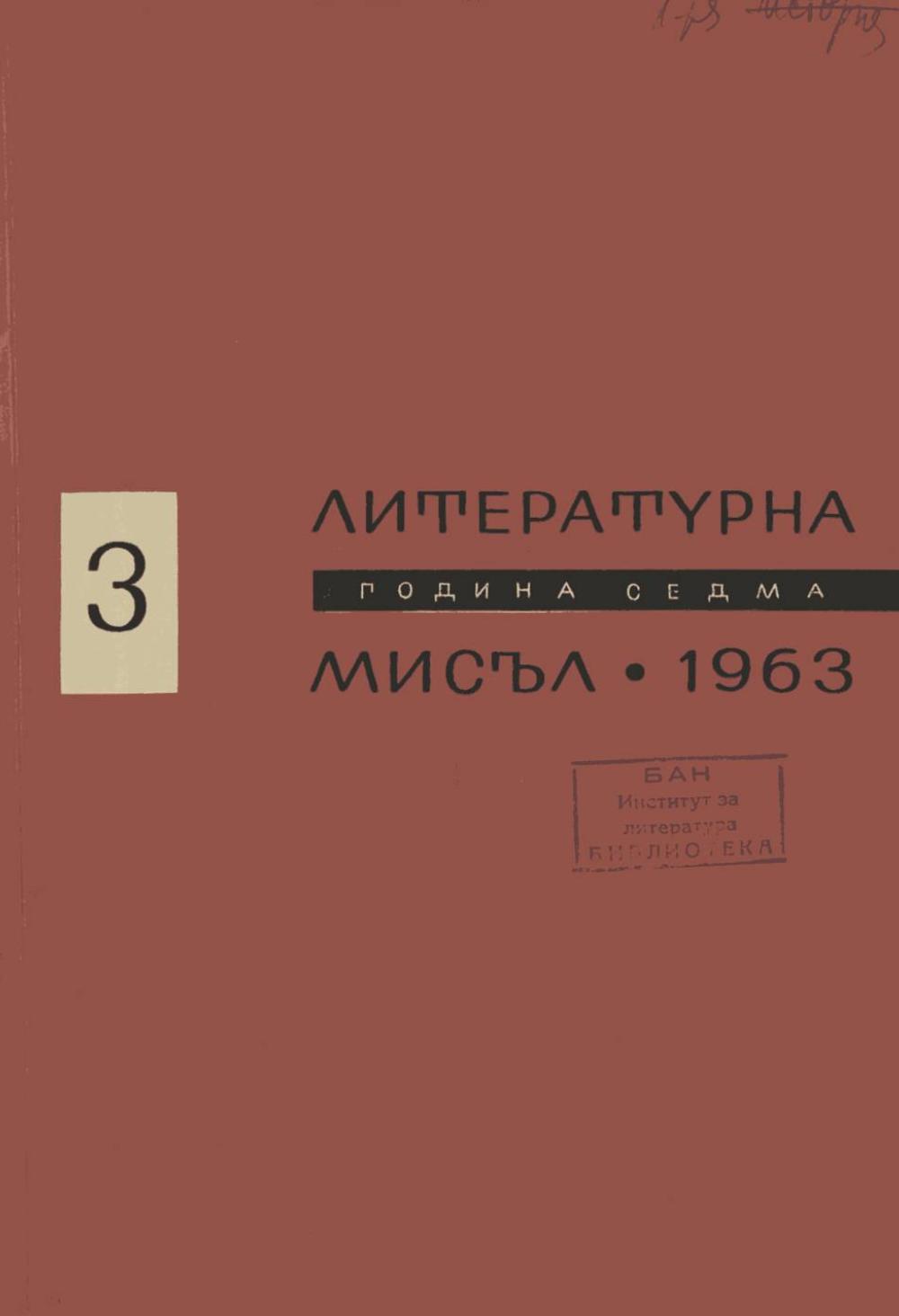
ДВУМЕСЕЧНО СПИСАНИЕ ЗА ЕСТЕТИКА, ЛИТЕРАТУРНА ИСТОРИЯ И КРИТИКА
-
PublisherПечатница на Държавното военно издателство при МНО
-
ISSN (online)1314-9237
-
ISSN (print)0324-0495
-
Pages170
-
Format700x1000/16
-
StatusАктивен
Literaturna misal Contents
Free access
-
Summary/Abstract
Summary1963 Book 3 ContentsKeywords: Съдържание
Todor Zhivkov Communist ideology – the supreme principle of our literature and art. Speech at the meeting of the Politburo of the Central Committee of the Bulgarian Communist Party with figures on the cultural front, delivered on April 15, 1963.
Free access
-
Summary/Abstract
SummarySPEECH OF COMRADE TODOR ZHIVKOV AT THE MEETING OF THE POLITBURO OF THE CENTRAL CENTRAL CENTRAL PARTY WITH WORKERS OF THE CULTURAL FRONT, DELIVERED ON APRIL 15, 1963 Dear comrades, At the beginning of April, as Comrade Mitko Grigorov announced in his opening remarks, a meeting lasting several days was held at the Central Committee of the Party with a wide range of representatives of the creative intelligentsia and other workers of the ideological front - the leaderships of the creative unions, the bureaus of the party organizations at the creative unions, the editors-in-chief of the central daily newspapers, the editors-in-chief of newspapers and magazines on issues of literature and art, the leaderships of the ideological institutes, of cinema, theater, radio and television, the secretaries for propaganda and agitation of the district committees of the Party, the members of the ideological commission of the Central Committee of the Party and the Council of Ministers. The meeting held a frank discussion on the urgent issues that concern our cultural community, and discussed in detail the work of the creative unions to implement the party decisions, and in particular the decisions of the Eighth Party Congress in the field of literature and art. The meeting of the Central Committee of the Party once again unequivocally confirmed that the vast majority of our creative intelligentsia correctly understands the role and tasks of the ideological front at the current stage in the development of our country and tirelessly and consistently implements the policy of our Party after the April Plenum of the Central Committee and the decisions of the Eighth Congress of the Bulgarian Communist Party. What comments could arise in connection with this meeting of ours?Keywords: Комунистическата, идейност, висш, принцип, нашата, литература, изкуство, срещата, Политбюро, дейци, културния, фронт, произнесена, април
Petar Dinekov The work of Cyril and Methodius and the development of old Bulgarian literature
Free access
-
Summary/Abstract
SummaryThe work of Cyril and Methodius is very diverse, can be viewed from different angles and raises many questions. One of the most interesting is the question of its connection with the development of Bulgarian literature. Some will say that this goes without saying - Cyril and Methodius are organically intertwined in the history of Bulgarian literature, without their work its emergence is unthinkable; everything is clear here, there is nothing to dispute and nothing to add. In fact, the questions are more complex than they seem at first glance. Let us take just two of them. On the one hand - were there not manifestations of Slavic writing in Bulgaria before the time of Cyril and Methodius and in that case can their work be considered the beginning of Bulgarian literature? On the other hand - is not a work included in the history of Bulgarian literature that developed up to the Moravian mission in the sphere of Byzantine culture, and then - among the Western Slavs? Is this not a stage of pan-Slavic literature that had a strong influence on the development of old Bulgarian literature, but did not enter into its history? That these questions have not been fully resolved, and at the very least - there is no agreement on them, is clearly visible when we turn our attention from the literary work of Cyril and Methodius to their language - it still bears different names in science: Old Church Slavonic, Old Church Slavonic, Old Bulgarian.Keywords: делото, Кирил, Методий, развитието, старата, българска, литература
Bogomil Nonev Science, poetry, modernity. A few impressions and reflections on the pages of scientific memoirs and poetry books
Free access
-
Summary/Abstract
SummaryAt the beginning of this century, the famous physicist Hautermans discovered that nuclear explosions are the source of the great solar energy. This is a brilliant insight that later gave rise to unprecedented results in the development of modern sciences. They give reason to many people to call the time in which we live - the atomic age. TOR Hautermans returns in his memories to his youth, when he reached the conclusion of his several years of research and reflections. And he tells of that day of joy from the scientific discovery, in which the imagination quickly draws new perspectives and scientific programs for work, as if bathed in the sunshine, giving rise to new hopes and the will to penetrate the depths of the secrets of nature. "But that same evening," he continues, "I went out for a walk with a beautiful girl. When it got dark and the stars, in all their splendor, began to appear one after another, my companion exclaimed: "How beautifully they shine, don't they?" I puffed out my chest and said importantly: "Since yesterday I know why they are glowing." But it immediately became clear to me that my statement did not move her at all. It was possible that she simply did not believe me. But, it seems to me that at that moment she did not feel the slightest interest in any problems.Keywords: наука, Поезия, съвременност, Няколко, впечатления, Размисли, страниците, научни, мемоарни, поетични, книги
Panteley Zarev Aleko Konstantinov
Free access
-
Summary/Abstract
SummaryAleko Konstantinov belongs to the generation of writers from the 1990s, which has immortalized itself for generations. And that - both with the criticism of social reality and with the fresh poetics of the artistic form. The works of "the most cheerful Bulgarian writer were born in the midst of sharp social struggles. In them, an image of a distant reality stands out. But they are not history. Because their author, having penetrated the depths of humanity, has captured characters and spiritual movements that carry typical human traits, immortal, secrets" of Mammon's passion. Because in them one can see the captivating artistry of a writer with a delicately gentle, exquisitely noble spirit.Keywords: Алеко, Константинов
Nikolay Donchev Henri Barbusse, humanist writer and soldier of peace
Free access
-
Summary/Abstract
Summary1963 Book 3 Henri Barbusse, humanist writer and soldier of peaceKeywords: Анри, Барбюс, писател, хуманист, войник, мира
Gancho Savov Signs of renewal in today's Yugoslav literature
Free access
-
Summary/Abstract
SummaryA serious and difficult problem is finding the new in contemporary Yugoslav literature. This is due to the great diversity of literary methods, trends and schools, each of them with its own "family" concepts and principles, with its own talented representatives and, of course, with arguments that they are the bearers of the new. And it is practically impossible to give an objective assessment right now of some of these creative methods whether they are really new or just an unlived fashion. (The old is easily recognized!) All this is because poetics follows poetry.Keywords: Признаци, обновление, днешната, югославска, литература
Georgiy Gachev Formation of the literary and artistic image and the division of literature into genera and types in Bulgaria in the 1840s.
Free access
-
Summary/Abstract
SummaryI predict that the reader will be perplexed when he reads the title of this article: is it possible that such general theoretical questions as the formation of the artistic image and the division of literature into genera and types can be solved or examined on the limited material of a literature for one decade and taken at that not in its best era: because in the 1840s of the 19th century, neither Botev, nor Vazov, nor Karavelov, nor Petko Slaveykov, nor Rakovski, nor even Chintulov had yet appeared on the literary horizon in Bulgaria. The literary field is mainly occupied by poets such as Neofit Rilski, Neofit Bozveli, Rayno Popovich, Konstantin Ognyanovich, Naiden Gerov and others.Keywords: Формиране, литературно, художествения, образ, разделянето, литературата, родове, видове, България, през, години
Svetozar Tsonev A look into Debelyanov's creative laboratory
Free access
-
Summary/Abstract
SummaryHow Dimcho Debelyanov worked on his poems, how the creative process unfolded for him, how the poet managed to "subjugate" the word to his poetic temperament, to infuse it with his own melodies of the soul, how the individual theme, image, feeling was born in him - the answer to these questions is determined not least by the specific analysis of the numerous corrections in his own poems.Keywords: поглед, творческата, лаборатория, Дебелянов
Dimo Minev Letters from Bulgarian writers
Free access
-
Summary/Abstract
SummaryWe have received your letter, together with the material. We are glad that our youth, although in foreign countries they are busy with the difficult science of courses, do not forget the great and sacred duty to the dear and dear fatherland, and this phenomenon shows that our people want to live a long and lasting life - God willing! Work, brother, work, while your strength is fresh, your energy strong and your imagination ardent: do not let this fiery and winged time fly away uselessly into the irretrievable eternity of eternity. We are glad of this phenomenon and we will place your works in Trud with great pleasure. Polish literature is rich in stories, and you are there among it: from it, from German and etc. choose the color and that which is in accordance with our reviving our young literature - things that will bring tangible benefit to our people. From the letter itself and from the material it is clear that you work conscientiously and accurately. May your example serve as an example to other young people! Even though we do not know each other personally, we see that you have spirit and talent: do not let your talent go to waste - reveal it to the world and, God forbid, may it take refuge and fly over Bulgarian life, inspiring it and leading it to the beautiful and morally useful.Keywords: писма, Български, писатели
Hristo Brazitsov One hour with Georgi Raichev
Free access
-
Summary/Abstract
SummaryThe author of the present had a conversation in December 1943 with Georgi Raichev in order to print my conversation along with a dozen others in a book under the title "Meetings and Conversations", published by Hr. Cholchev. However, the Anglo-American bombings on January 10, 1944 buried the book in the "Economic Development" printing house on Bacho Kiro Street. The conversation with Georgi Raichev has been preserved thanks to a proofreading. We are transmitting it without any changes.Keywords: един, Георги, Райчев
Lilyana Minkova New research on Lyuben Karavelov
Free access
-
Summary/Abstract
SummaryIn recent years, much has been written about Karavelov. His work and political activity are examined in the works of Bulgarian and Soviet writers, historians, philosophers, and linguists. A contribution to resolving a number of issues related to the enormous work of the notable Renaissance man is also represented by the studies included in the recently published collection "Studies and Articles on Lyuben Karavelov", published by the Bulgarian Academy of Sciences, S. 1963. A significant part of the articles are devoted to the ideology of Lyuben Karavelov. This is perhaps due to an effort to finally resolve, albeit in general terms, the question of the nature of Karavelov's ideology, which has already been the subject of very lengthy disputes. It is to be regretted, however, that very little space has been devoted to Karavelov the writer and journalist. Two of the studies prove Karavelov's authorship of articles and other materials that have not been included in his legacy until now. The collection also examines issues related to Karavelov's attitude to the traditions of Bulgarian literature, Karavelov's work as an editor, etc. The subject matter of the collection is clearly too diverse, and this makes it very difficult to group the articles by problem. The authors have touched on different aspects of Karavelov's multifaceted activity, and uniting their studies would be rather arbitrary.Keywords: Нови, проучвания, Любен, Каравелов
Docho Lekov A new work on the work of Sophrony
Free access
-
Summary/Abstract
SummaryTradition has forever linked the names of two prominent representatives of the Bulgarian revival - Paisius and Sophrony of Vrachanski. And not by chance. The Kotla priest Stoyko Vladislavov was the first to transcribe "History of Slavonic Bulgaria", the first to understand and implement as a writer and public figure the national and universal ideas of the Hilendar monk. In 1962, the 200th anniversary of the writing of "History of Slavonic Bulgaria" was celebrated - articles and studies were published in the periodical press and scientific publications that shed light on important moments in the work of the immortal revivalist. Just a few months later, a monograph on the life and creative path of Sophrony of Vrachanski appeared. Its author, the famous specialist in Old Bulgarian literature V. Sl. Kiselkov, has shown interest in Sophrony as a scientist and citizen, because, as he notes in the introduction to his work, he was born and raised "in the birthplace of Sophrony" (p. 4). Therefore, the tracing and interpretation of the facts is often warmed by a warm feeling for his native land, by reverence for its historical past, by a captivating enthusiasm for the work of notable Kotel residents. V. Sl. Kiselkov's aspiration to outline the era and activities of Sophrony as completely as possible, to challenge established concepts and propose new ones, has determined both the composition of the monograph and the volume of its individual parts. It is made up of four mutually complementary chapters: 1. Kotel; 2. From the cradle to the grave; 3. Writer's image; 4. Literary work.Keywords: труд, върху, делото, Софроний