• Name:
    Georgi Dimov
  • Inversion: Dimov, Georgi

Free access
  • Summary/Abstract
    Summary
    The increased interest in our cultural heritage requires us to approach it critically, with love and understanding, with scientific awareness and civic responsibility. From a serious publication, our contemporary reader must learn when and under what specific historical conditions the work was written, what the writer's subjective creative motives were, and how to understand certain ideological and aesthetic peculiarities. The need for a critical apparatus is particularly important in the case of works whose authors have followed a complex and contradictory ideological and creative path. The comprehensive critical edition of Ivan Vazov's works is a serious attempt to present the work of the great Bulgarian classic in a form that meets the requirements of people with different interests and is at the level of the current development of our literary and archaeographic science.
    Keywords: опознаване, изучаване, литературно, наследство

Free access
  • Summary/Abstract
    Summary
    Todor Pavlov belongs to those creative personalities who, with their fruitful activity, open up new horizons for scientific thought. That is why they attract and will attract the attention of both contemporaries and future generations, of all who strive to become related to the great creative individuality - who has seen truths, the knowledge of which enriches man, pushes him towards new quests, towards an ever greater tension of thought and of the will to master the laws of society and nature. The fascination of such people increases immeasurably when the penetrating thought is carried by a great human heart, when their scientific knowledge is combined with highly humane moral principles.
    Keywords: Бележит, марксист, естет, литературовед

Free access
  • Summary/Abstract
    Summary
    The history of Bulgarian Literature is long. Originating in the 9th century, it gradually achieved great conquests, had a beneficial impact on other Slavic peoples, while at the same time learning from the world's masters of the artistic word. Today, the work of writers, writers and poets is increasingly attracting the attention of scholars from different countries. This interest is constantly growing not only in old Bulgarian literature, when our literary thought reached an unusual flourishing for that time, but also in more recent periods, in the Revival and post-liberation literature, in the achievements of our contemporary artistic word. And if learned Slavists turn to our literary works in order to reveal their connections with the artistic thought of other peoples, to point out their historical and cognitive significance, to understand the general and specific laws of their development and the literary process in general, then thousands of readers reach for one or another work in order to relate to the past and present life of our people, to experience their long-standing, epic struggles for national Independence, social justice and cultural progress, to feel the pathos and heroism of today's glorious socialist modernity. This continuous interest also finds expression in numerous articles, essays, in a number of studies on specific issues, as well as in more general works. Recently, attempts have also appeared for a more comprehensive exposition of our literary development. Here too, Soviet science, continuing the traditions of Russian Slavic thought, works with its inherent scope, noting undoubted successes - the largest of which in recent times is the voluminous volume "Essays on the History of Bulgarian Literature of the 19th-20th Centuries", prepared by Bulgarian literary scholars at the Institute of Slavic Studies at the USSR Academy of Sciences, Moscow. Along with the many individual studies, articles, and books on specific historical and literary issues, we are already aware of some partial attempts by Soviet literary workers to give a popular systematic exposition of more comprehensive periods of our literary development. Without underestimating the importance of these attempts to popularize Bulgarian literature, it should be emphasized that they lag far behind the work prepared at the Institute of Slavic Studies. The team of "Essays on the History of Bulgarian Literature 19th-20th Centuries" has taken a much broader and more in-depth look at its task, has carried out significant research work and has achieved undoubted results. And what is even more important. This work is the first more comprehensive attempt to examine literary development over the last century from Marxist positions, to see literary phenomena in their complexity and contradictions, to summarize and explain them by a single scientific criterion.
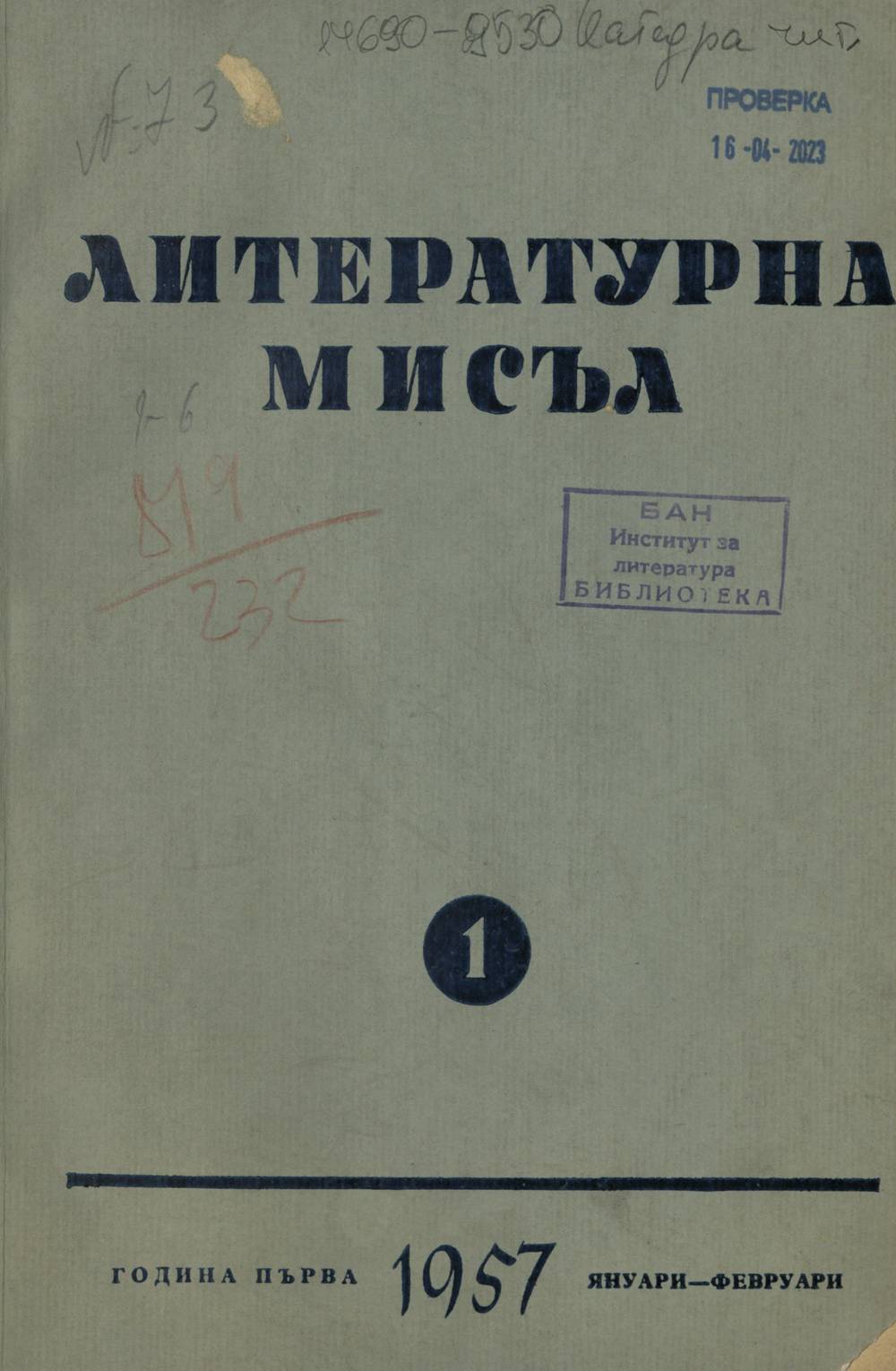
    Keywords: Забележителен, успех, съветската, белетристика

Free access
  • Summary/Abstract
    Summary
    From November 11 to 16 of this year, a meeting of the International Committee of Slavists was held in Sofia. For six days, some of the most prominent representatives of Slavic thought in the world held creative conversations, talked, and debated in order to identify and formulate the most current problems of Slavic studies. The direct goal of the meeting was to discuss the issues and topics for the upcoming Fifth International Congress, which will be held in Sofia in 1963. As hosts of the meeting and the upcoming congress, the Bulgarian Slavists were tasked with developing a draft of the problems and topics that would serve as a basis for the discussion. The draft was compiled and promptly sent to the national committees of Slavists in the individual countries, so that it could be discussed by all scholars dealing with the problems of Slavic studies. The meeting showed that the interest in the thematic program of the future congress is extremely high and that scholars from Slavic and non-Slavic countries who deal with one or another issue of Slavic studies are preparing to take an active part in the future congress in order to shed new light on the most important problems of Slavic studies.
    Keywords: Плодотворна, славистична, Среща

Free access
  • Summary/Abstract
    Summary
    In world literary history, there are artists whose historical significance becomes more and more evident with the passage of time, who push for reflection, for new quests of the mind and heart. Such a notable personality is V. G. Belinsky, 150 years since the birth of whom today the progressive public from all countries marks with gratitude, making new efforts to delve into the rich heritage of this great son of the Russian people in order to establish the impact of his revolutionary-political, theoretical-philosophical, literary-critical thought on and later generations. contemporaries Having passed an instructive path of ideological and creative development, Belinsky stands on the most progressive positions of his time, understands the needs and tasks of the era, strives for new revolutionary concepts of social, ethical and aesthetic values. Many of the principles he established still resonate today with undiminished force, have lost none of their vital relevance, and serve as the basis for further research. Belinsky's multifaceted and rich work seems to embody the comprehensive spirituality of the great Russian people, as if the socio-political, moral-philosophical, and literary-theoretical problems of the era are gathered. The insights of the great thinker cut through the gloomy atmosphere of bourgeois-landlord Russia like lightning - groaning and struggling against oppression and injustice, against the Nicholas monarchical dictatorship, and outline the radiant horizons to which human thought has been striving for centuries. What excited and worried his contemporaries, what flashed in the minds of honest people, disturbed the squeamish consciences of all sorts of oppressors of the human person, manifests itself in Belinsky with astonishing power, to charm and inspire the wronged, to frighten those in power. His articles take up the most pressing issues of the time, are met as a revelation. In them one feels the bubbling of an immense energy, the daring of a penetrating thought, the rebellion of a restless civic pathos of a loving heart.
    Keywords: Белински, някои, въпроси, българската, Литературна, критика, през, Възраждането

Free access
  • Summary/Abstract
    Summary
    In the first decades after the Liberation, the socio-historical needs of the Bulgarian people required scientific and cultural figures to work on a broad front, to undertake and implement numerous initiatives, to demonstrate civic responsiveness and foresight in order to lay solid foundations for the developing national science and culture. If one part of the post-liberation intelligentsia was carried away by the political demagogy and careerism of the ruling bourgeoisie and their actions deservedly provoked the criticism and indignation of the best realist writers, then another significant part gave their talents and knowledge to the flourishing of education, science, and literature. The great socio-patriotic, ideological, and moral-ethical traditions of the Revival era continued to be a source of inspiration for them to serve devotedly for the all-round progress of our newly liberated people. Among these enthusiastic builders of our national culture, the personality of Prof. Iv. D. Shishmanov. His diverse and fruitful work as a scientist and cultural figure, as a citizen-humanist and a patriot writer is a valuable contribution to the spiritual and intellectual development of our people from the end of the last and the first decades of the current century. Here it is not our task to consider the contribution of Iv. Shishmanov in the numerous areas in which he worked. We will only point out the role of the prominent scientist-humanist in the development of our literature through the comprehensive support he gives to writers and poets, through the rare responsiveness to their needs and aspirations. Shishmanov is one of the few at that time who with such great love and concern follows the development of our national artistic and scientific thought, seeks all possible means and forms in order to create the necessary conditions for the manifestation of creative talents, for the emergence of literature with great ideological-cognitive and patriotic-emotional significance. A trained literary historian and critic who has studied the development of many other national literatures, he accurately sees where the necessary prerequisites are hidden for talents to grow and manifest, what needs to be done so that they are properly nurtured and not wasted. The history of world literature has taught him that artistic thought develops on the basis of a higher culture of the entire people, that its bearers can only be people who live with higher socio-ethical and cultural-aesthetic ideals, but who can also find objective conditions for creative expression with such ideals. That is why he works with dedication to expand and democratize education, to raise the general cultural level of the people. "If you want a richer Bulgarian literature to develop - first of all, provide education and through education, give the opportunity to manifest the hidden talents that exist in all classes, but are silenced because they cannot find the necessary conditions for development." With proverbial persistence, for decades Shishmanov worked to organize a variety of cultural and educational institutes and institutions and deservedly occupies one of the first places among the builders of a new cultural Bulgaria.
    Keywords: Иван, Шишманов, българските, писатели

Free access
  • Summary/Abstract
    Summary
    The interdependence and interrelationship between the ideological-aesthetic and literary-artistic values ​​of different eras necessitate the comprehensive study and creative use of the achievements of previous generations. To see under what conditions certain achievements of national creative thought emerged, what needs called for them, what impact they had on broadening the horizons, on directing the searches of the mind, the excitements of the heart of the people of that time on the right path, is undoubtedly a primary task of our modernity. This is all the more necessary for those achievements that emerged in transitional eras, when the paths to a new life were being traced, when the spiritual forces of the people were particularly strained in order to win and affirm the right to free national existence and development. Such an era is undoubtedly the Bulgarian Revival. In that time of political slavery and spiritual darkness, when the Bulgarian nationality was put to great trials, our small intelligentsia had to strain its intellectual and moral forces to the limit in order to give the right direction to the awakening creative energy of the Bulgarian people, to lay solid foundations for the forming national literature and culture. To search for and collect the literary heritage of these first pioneers on our cultural level, to study and illuminate it comprehensively, so that it could truly become a support for the further development of scientific and theoretical literary and artistic thought, undoubtedly represents one of the duties of today's Marxist-Leninist literary studies. Belinsky's thought - in order to understand the present and predict the future, one must study the past, a thought insistently recalled by many people in creative pursuits, should not be forgotten by today's generations.
    Keywords: Книжовното, наследство, Нешо, Бончев

Free access
  • Summary/Abstract
    Summary
    In the history of Bulgarian literature, Vasil Drumev occupies a certain place not only as a fiction writer and playwright, but also with his versatile critical activity. His literary-critical, cultural-historical and other articles create for him a name of a gifted and educated man of letters, who worked with love and understanding for the development of national literature, science, culture. He is one of the few Renaissance writers who received a relatively more systematic education and had the opportunity to study the literatures of other nations for a longer period. Thus, the natural talent of the author of the first Bulgarian novel, the aspiration that possessed him since adolescence and to serve the spiritual revival of his people with his pen find favorable conditions for maturation and development. And if the talented writer had not changed his calling precisely in the heyday of his creative powers, if he had not accepted the spiritual dignity, he would undoubtedly have enriched our national artistic and theoretical-critical thought to a much higher degree.
    Keywords: Васил, Друмев, литературно, теоретически, критически, позиции

Free access
  • Summary/Abstract
    Summary
    In its centuries-long socio-historical development, the Bulgarian people created deeds that left deep furrows in the minds and souls of people, riveted the gaze of contemporary and later generations, and continue to excite and inspire in the struggle for social and cultural progress, for justice and happiness in the world. Such an epoch-making deed in its ideological-revolutionary aspiration and moral-social essence is also the people's anti-fascist uprising in September 1923. It is a natural result of the socio-political development of our country after the First Imperialist War, it is conditioned by the efforts to resolve the maturing social contradictions and marks a turning point in the overall life of our people.
    Keywords: Септемврийското, въстание, преломен, момент, българската, литература

Free access
  • Summary/Abstract
    Summary
    The great creators of artistic values ​​are the few people marked by fate who outlive their time, cross the borders of many countries, attract attention, evoke the admiration and gratitude of more than one generation. The great charming power and eternal significance of these creative personalities are as significant and comprehensive as the more organic the connection between artistic achievements and social behavior, between ideological and aesthetic insights and civic and ethical aspirations. Such people, like a beacon, attract the eyes of all who live with the impulses of a more intense life, are possessed by higher ideals of social progress and moral elevation. Readers of different generations and eras turn to the work of such creators in order to relate to what they have achieved as artists and citizens. Getting to know their mental and emotional world, their trials, insights and conquests serves as a support and prerequisite for further development of national and universal literature and culture. Such a charming personality is undoubtedly the great citizen-humanist and writer-realist Aleko Konstantinov.
    Keywords: Алеко, Константинов, българската, Литературна, критика

Free access
  • Summary/Abstract
    Summary
    Dimitar Blagoev belongs to those creative personalities whose work we remember not only on anniversaries and celebrations. With all the enormous achievements of modern thought in various fields of human knowledge, the traditions and testaments of these notable personalities retain all their vitality and timeless significance. Generations from different eras turn to their work to draw knowledge and wisdom, lessons and inspiration in their efforts to realize high social and cultural ideals. Therefore, such historical figures are not only our teachers, who have given us a true compass for orientation in the complex problems of life, but also our living contemporaries, suggesting to us the direction to the great truths.
    Keywords: Димитър, Благоев, Борец, срещу, идеалистическо, формалистическата, естетика, критика

Free access
  • Summary/Abstract
    Summary
    The liberation of Bulgaria from centuries of Ottoman oppression opens up wide opportunities for the unleashed national spiritual and creative energy. Having manifested itself with unsuspected force and so brightly during the last decades of the glorious Renaissance era, now with the changes in socio-political life it marks new significant successes in various fields of knowledge. The cultural-historical, literary-artistic, critical-aesthetic traditions of the Renaissance are being revived and rethought, in accordance with the new social reality. It also nourishes the emergence of new phenomena and trends. Although the liberation of 1878 created a new stage in the socio-political and socio-economic development of the Bulgarian people, in the field of spiritual and intellectual activity during the decade immediately after the Russo-Turkish War, we are witnesses of a very broad ideological and aesthetic continuity. Here, the processes seem to continue in the same direction, they show greater vitality, their pace is not so rapid.
    Keywords: българската, Литературна, критика, през, години

Free access
  • Summary/Abstract
    Summary
    In the centuries-old historical destiny of our people, there are eras rich in events and personalities that most fully reveal our national essence, synthesize the most intimate in the efforts of the Bulgarian for national affirmation, social-moral and cultural empowerment. That is why, like a beacon, they have attracted, retained and will direct the gaze of scientists and artists, historians and sociologists, philosophers and psychologists. Such a comprehensive and incredibly intense era undoubtedly represents the era of national liberation struggles, the epilogue of which was the April Uprising of 1876. For nine decades now, this event, magnificent in its conception and organization, in its ideological and emotional saturation, in its social and moral impulses, has been emitting an irresistible radiance. Crowned with the halo of immortality, it pushes us to reflect, confronts us with ever new problems. Prepared for decades with dedication and boundless sacrifice, conceived and guided by bright minds and ardent hearts, it came to show the world the greatness and tragedy of the Bulgarian tribe, to evoke the admiration of honest people, to disturb the public conscience, to throw confusion into the minds of European statesmen and diplomats. And most importantly - to strengthen the belief that "we are not forever submissive to them", that the land - soaked in blood for centuries and strewn with bones - will no longer tolerate a foreign enslaver, it has nurtured the most cherished dream - freedom and justice of the people.
    Keywords: художествена, летопис, Априлската, епопея

Free access
  • Summary/Abstract
    Summary
    Due to centuries of foreign oppression, the Bulgarian nation underwent a peculiar socio-historical development. Our national revival began only in the second half of the 18th century. However, cultural and historical processes have become particularly intense since then. In just one century (1762-1878), national creative thought went through several stages, only to soon rise to great heights. Continuing the traditions of the Revival, literary science from the beginning of our century quickly expanded its problematic, adopting reliable principles for a more comprehensive interpretation of cultural and aesthetic phenomena and processes. Both the great writers and critics of the Revival, and the few academically educated literary scholars after the Liberation, demonstrated a number of correct understandings regarding the diverse prerequisites for the formation of the Bulgarian national culture and literature, regarding the interrelationships and interdependence of the ideological and artistic phenomena of the individual peoples. Directing their research gaze towards the problems of our national revival, the first great Bulgarian literary historians realized that they could not be comprehensively and truthfully illuminated if one did not take into account similar processes and phenomena in neighboring countries - Greece, Serbia, Romania, Russia, with which our people communicated in different ways, through diverse forms.
    Keywords: българската, Литературна, наука, проблемът, сравнително, историческото, изучаване, балканските, литератури

Free access
  • Summary/Abstract
    Summary
    One of the most characteristic features of the new Bulgarian literature is that it is born and develops in organic unity with the national socio-historical and cultural-moral processes. Its first representatives lived and created with a clear awareness of its great role in the development of national self-knowledge, they sought various forms and means to direct creative thought on the right path. The era from Paisius to Botev, an era in which the foundations of our national literature were laid, is incomparably grand in civic pathos and creative tension, in intellectual-spiritual insights and artistic conquests. The struggle for political and cultural independence - understood in all its comprehensiveness, depth and meaning, is accompanied by an equally stubborn struggle for sound national aesthetic and artistic principles. With artistic speech, with cultural-publicistic and literary-critical articles, with writings of the most diverse genre and thematic aspects, people, possessed by creative impulses, strive to create a nationally distinctive literature, in tune with the needs of life, passionately fight against the primitive and retrograde in social and aesthetic understandings. A rare dedication and foresight characterize the work of these pioneers of national literary thought. The artistic and critical-theoretical traditions established by them have served as a support and inspiration for later works.
    Keywords: Иван, Вазов, борбата, създаване, национално, самобитна, реалистична, литература

Free access
  • Summary/Abstract
    Summary
    "History will have to think about which immortal figure to attribute you to!" - this is how Vazov exclaims in amazement in his remarkable "Epic of the Forgotten", when he recreates the image of Rakovski. The folk poet is as if stunned by the personality and versatility of the work of this "mad dreamer, an impossible image", seething with "giant love" and "satanic enmity", who boldly peered into the dark past to reveal the tragic present and embrace the dreamed future with his eagle gaze. For all its romantic hyperbolicity, this poetic glorification seems to most accurately capture Rakovski's extraordinary scale in ideological insights and revolutionary scope, in national impulses and efforts to serve devotedly a great idea with thought and deed, with pen and weapon. One is truly amazed by this all-encompassing, revolutionary, uniquely original, spiritually rich personality. The scope of the revolutionary, the searches of the historian, the insights of the scientist, and the visions of the poet - everything is nourished by a deeply realized and suffered national ideal, which found a kind of synthesis and expression in his entire activity. The scale and significance of this activity seem to go beyond national dimensions and remind us of the great conquests of the human spirit in general.
    Keywords: Георги, Раковски, развитието, българската, литература

Free access
  • Summary/Abstract
    Summary
    In the era of the Bulgarian Revival, deep and diverse processes are taking place, which fill the socio-economic and spiritual life with new content. On the basis of the objectively created historical prerequisites, the Bulgarian nation is formed, with all those components that accompany its affirmation. In long-standing efforts for national individualization, for the conquest of political and cultural independence, it manifests itself with unsuspected vital energy. National social, scientific, aesthetic thought is rapidly gaining strength.
    Keywords: Принос, проучването, националното, Възраждане, българското, книжовно, дружество, Браила, Михаил, Арнаудов

Free access
  • Summary/Abstract
    Summary
    Although it has long traditions, comparative literary studies has attracted in recent years an increasingly wide circle of representatives of historical-literary, critical and theoretical-aesthetic thought. In the efforts to study the general and specific laws of literary development, to illuminate artistic phenomena from more sides, both as a result of national, concrete-historical conditions, and as phenomena in the fabric of which we find much similarity, resulting from the constant relationships with what was conquered by other peoples, comparative interpretation is proving to be increasingly effective. An indisputable contribution to this direction is made by Marxist literary studies, which, overcoming the limitations of bourgeois comparative studies in the past, in dispute with contemporary idealistic concepts and methods, places the comparative consideration of artistic processes and works on a broad socio-historical, cultural-sociological, philosophical-aesthetic basis. In this way, not only are the prerequisites and driving forces for the development of national literatures revealed, but on the basis of their study, a more complete illumination of the general processes characterizing the literary life of many countries and peoples is achieved.
    Keywords: международен, форум, проблемите, Сравнителното, литературознание

Free access
  • Summary/Abstract
    Summary
    The historical fate of the Bulgarian people has not been particularly favorable for the free and full expression of its intellectual and creative potential. Nevertheless, the national conquests in various fields of knowledge, of spiritual life in general, give us every reason to be proud, to present ourselves with dignity to the outside world. In less than a hundred years of independent national and political life, scientific thought has developed with rare intensity and today we can already compete with other advanced nations with dignity. Therefore, all the greater are the merits of those pioneers of scientific research who had to plow virgin lands, to blaze trails, especially in the field of Bulgarian studies. They were destined to overcome innumerable obstacles of every nature, to overthrow layered prejudices, to dispel the fog with which some wanted to veil our nationality. The primary task of the people of humanitarian scientific thought was to bring our centuries-old cultural heritage out of oblivion, to reveal the cultural-historical, moral-aesthetic riches of previous eras, to study and make known the spiritual conquests of new generations, to clear the way and create the necessary prerequisites for further advancement. And considering that the ruling circles in Newly Liberated Bulgaria, caught up in political disputes, in a race to get rich, did not care about the fate of people possessed by higher spiritual impulses, of the creative intelligentsia, the feat of those who, striving for new spiritual horizons, devoted themselves to scientific research activities in order to shed light on the diverse problems related to the past, present and future of our people, will stand out even more clearly. That is why our gratitude to these builders of a new cultural Bulgaria, who went through many trials, but remained faithful to their calling, to their national duty - to elevate our national scientific thought to the level of advanced cultural nations, is today all the greater and historically justified.
    Keywords: науката, призвание, съдба, един, живот

Free access
  • Summary/Abstract
    Summary
    When more than three decades ago, the unknown village teacher Krum Grigorov made his literary debut with his story "The Border", few could have guessed that these were the first sprouts of the future storyteller of the Bulgarian village. The small stories that soon appeared on the pages of the progressive periodical, written with a vivid sense of life's injustices, began to attract more and more attention from the reader. In them, the persistent efforts of the village teacher towards an artistic expression of his ideological anxieties and social aspirations stand out more and more clearly. And quite naturally, he soon found his place among progressive writing circles, joining the ranks of the anti-fascist literary front, which in the 1930s was rapidly growing and setting the tone for artistic life.
    Keywords: писател, българското, село, Крум, Григоров

Free access
  • Summary/Abstract
    Summary
    One of the characteristic features of the contemporary literary process is its genre diversity. This applies equally to both fiction and literary criticism. Artistic aspirations and generalizations, the searches and insights of historical-literary and critical thought find expression in various genres and forms, sometimes very heterogeneous, but nevertheless interesting as evidence of the richness of literary life, of the diversity of creative individuals, of the different paths that writers and literary critics take to reveal truths of an ideological-aesthetic, biographical-creative, moral, and emotional nature.
    Keywords: Принос, психографията, характерологията, Български, писатели, Георги, Караславов, близки, познати