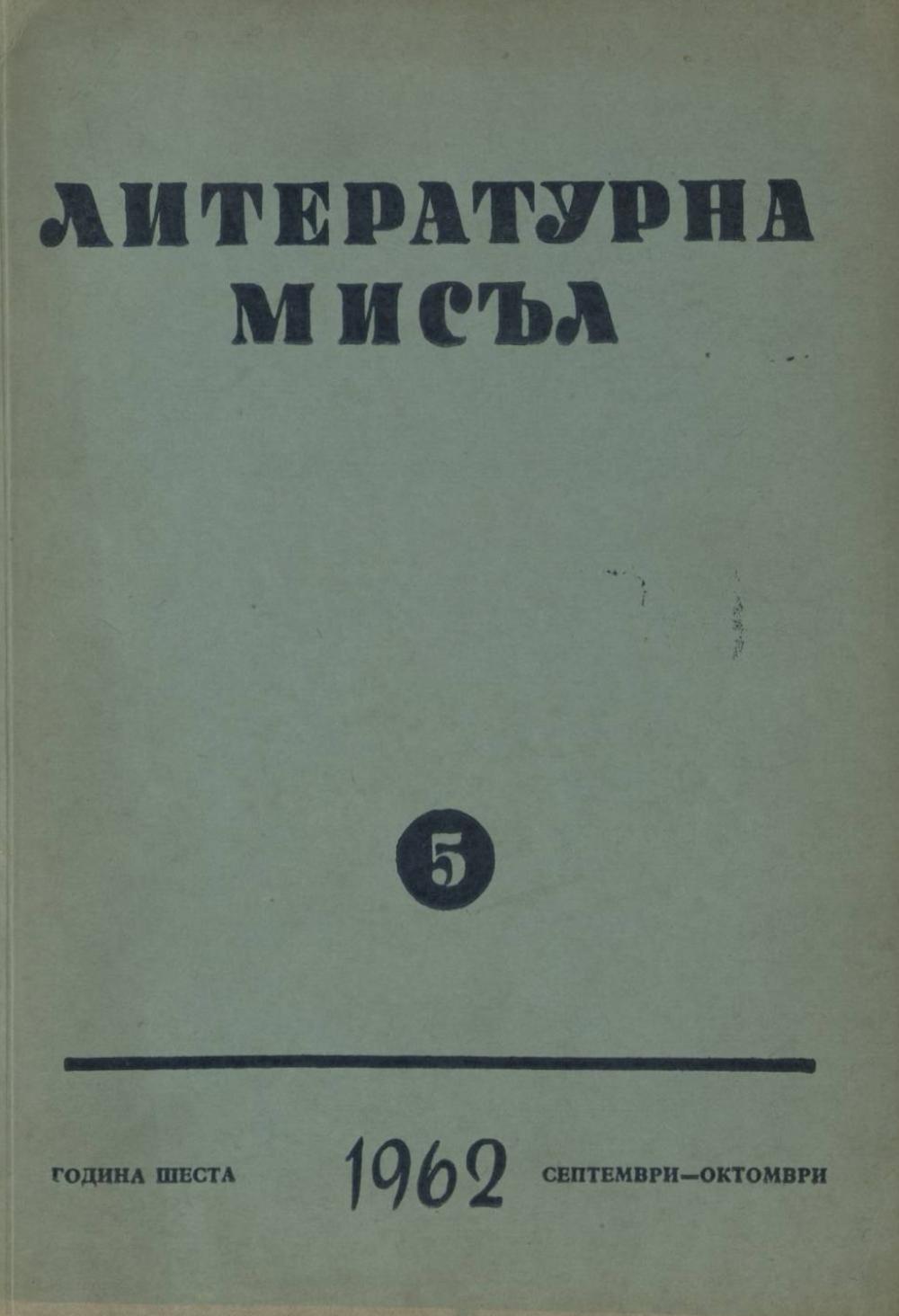
-
ДВУМЕСЕЧНО СПИСАНИЕ ЗА ЕСТЕТИКА, ЛИТЕРАТУРНА ИСТОРИЯ И КРИТИКА
-
PublisherПечатница на Държавното военно издателство при МНО
-
ISSN (online)1314-9237
-
ISSN (print)0324-0495
-
Pages145
-
Format700x1000/16
-
StatusАктивен
Literaturna misal Contents
Free access
-
Summary/Abstract
Summary1962 Booklet 5 ContentsKeywords: Съдържание
Literaturna misal * * * Congress of Great Perspectives
Free access
-
Summary/Abstract
SummaryIn the party's activities, congresses have always been the most important forum for taking stock, for checking what has been accomplished and for drawing up the general lines of future development. How much more does this apply to the upcoming VIII Congress of the Bulgarian Communist Party! It is called upon to sum up the major results of a period of fruitful work and to adopt a plan for a communist offensive over the next twenty years. Our people have already deployed their initiative in the pre-congress discussion of the draft directives. They have adopted as their main goal the great economic task set by the party: to complete the construction of socialism and gradually move on to the extensive construction of the material and technical base of communism. The grandiose program in its scope envisages accelerating the pace of economic restructuring. In 1980, Bulgaria should be a country with a seven-fold increase in industrial production and an almost tripled agricultural output compared to 1960. This means fully revealing and fully utilizing the natural and material resources of our homeland, pursuing even faster rates of electrification, and bringing the struggle for technical progress to the forefront in all economic sectors.Keywords: конгрес, великите, перспективи
Stoyan Karolev Poetic idea and poetic image
Free access
-
Summary/Abstract
SummaryThere are sensitive natures who are no less excited than talented poets, but their excitement does not give rise to poetic ideas. It is not a question of the desire to compose, which can also overshadow those completely devoid of talent, but it is very distantly related to the artistic idea. In order for a poetic idea to arise, talent is needed. Talent, so to speak, is an innate mastery, the bearers of which must thank nature. And the greater the talent, the more condensed, more concentrated this potential mastery is. The young Pushkin wrote poems whose mastery would be envied by even great poets in their most mature creative age. Pushkin is a worldly genius. But our Smirnensky also created unfading poetic works in his early youth. By the way, he died almost a teenager, and amazes us with his poetic virtuosity. Another young man, Dimcho Debelyanov, created perfect poems before Smirnensky. Even earlier, the unknown Peyu Kracholov amazed such strict literary connoisseurs as Dr. K. Krastev and Pencho Slaveykov, who simply wondered how this boy from the backwater province managed to achieve such heights of poetic skill in "Calliope". And yet, poets usually do not write their most perfect works at the beginning of their creative path. And brilliant poets develop, acquire mastery through schooling from their great predecessors, through a lot of work, through enriching their life experience, etc. A poet is one - says Gogol - who is more capable than others of feeling the beauty of creation" ("Russian Writers on Literary Work", Leningrad, 1954, vol. I, p. 477). This feeling for the beauty of the world is undoubtedly strengthened in creative practice, which forces the poet to seek the beautiful, the wonderful in life and truthfully depict it, to sing it. The poet, like any artist, is gifted by nature with strong observation and impressionability. And they are sharpened in the process of work.Keywords: поетическа, идея, поетическо, изображение
Boris Delchev The Masculinization of the Artist
Free access
-
Summary/Abstract
SummaryIt is hardly possible to communicate with painters without hearing a complaint that is repeated all too often when it comes to portraiture: "It is a pain to paint." And this complaint, so widespread, does not surprise anyone. If there are "painful" things in any work, they will obviously also manifest themselves in the efforts to recreate the human image. There is nothing unusual in the fact that a painter fails to discover in a certain model such qualities that do not nourish his creative imagination and do not excite his thirst for search, or vice versa - does not find the strength within himself to rise to the spiritual and plastic tasks that another model sets for him. In both cases he is confronted with difficulties that apply with equal force to all the arts and are considered something quite natural in creative practice. However, something else will seem more strange - that these difficulties apply to a certain extent also to certain manifestations of human activity that lie outside the scope of art. Such a manifestation is literary criticism, which, although in a different area of spiritual interests, also has the task of discovering the characteristic in a person, taken as a creator of artistic values, and to outline his image with the means of the journalistic word. That is why the literary connoisseur, for whom to a certain extent the laws of inspiration also apply, in turn faces similar difficulties and in turn, for one reason or another, can say: "This author does not lend itself to me." At least I have had the opportunity to face such a failure more than once and give in. And I must admit that for many years one of the "tormenting" authors for me was none other than Radoj Ralin.Keywords: Възмъжаването, твореца
Petar Pondev A book about the destiny of the people
Free access
-
Summary/Abstract
Summary"Readers will notice that among my heroes, neither learned heads, nor important merchants, nor influential rich men appear very often; but simple and ordinary people, all from the lower ranks. These do not appear precisely because the work I describe is foreign to them." And so as not to leave any doubt about the purpose of his book, Zahari Stoyanov confesses: "Finally, I turn to you, brothers, simple poor people. For you I have worked hard to write this book, to show you that the most ardent fighters and defenders of our fatherland were not proud rich men and puffed-up scholars, but simple and uneducated brothers of yours, who knew no more than you. It will be enough to remind you only of the names of Levski, Benkovski, Kocho Chistemenski, the Zhekovi brothers, Bai Ivan Arabadzhiata, Ivan Vorcho, etc., all the guildsmen and workers. These, and no one else, washed the face of Bulgaria and defended our disgraced glory. With these words, Zahari Stoyanov turns to the readers of his "Notes", to explicitly remind them of whom he had in mind when he wrote them. The only and main character in them is the people, and he wants the people to be their first reader.Keywords: Книга, народната, съдба
Emil Georgiev Paisius of Hilendar and the ideological and literary trends of his era
Free access
-
Summary/Abstract
SummaryPaisii Hilendarski rises as a bright beacon among the historical and historical-literary processes that take place at one of the peak moments in our development - at the beginning of the Bulgarian Revival and the new Bulgarian literature. His work collects the light of the past and directs it forward into the future. As the founder of a new era, he has a clear view of its needs and sees deeply into the fate of our people. And the famous Slavo-Bulgarian History is not only a major work of new Bulgarian literature, but presents a program that sets the tasks of the Bulgarian Revival and charts a path for the development of the Bulgarian BO people. The bright figure of the first Bulgarian Revivalist has long attracted the attention of our science. However, the sources for both his activities and his era are scarce and the scientific search is struggling to find its way to his personality and to the processes that brought him to the brink of two eras, as a harbinger of a new moment in the historical and literary development of our people. Our Marxist historiography and literary studies - one might say - have already explained the essence of our Revival, which represents a period of transition from a feudal to a capitalist formation. However, a number of extremely important questions that the development during the era poses have remained unclear; Their solution would reveal to us more specifically the processes that lead to the appearance of the Slavonic-Bulgarian History in 1762 and that follow after this appearance, in order to complete in our country "the Great Engels Revival. 1 of a progressive revolution" - as he called it. Our general and literary historiography of recent times has rightly directed its attention not only to the phenomena that register the offensive movement and acquaint us with the picture of life and the achievements of culture and literature, with a number of personalities and works representing the individual moments and successes of our socio-historical and literary past, but also to the processes and laws of our development. However, in order for these processes and laws that drive our development to become fully apparent, Paisius' work and our Revival must be placed in the light of the general historical and historical-literary development that European peoples have undergone over the centuries.Keywords: Паисий, Хилендарски, идеологическите, литературни, течения, неговата, епоха
Georgi Valchev When the oracles leave the temple
Free access
-
Summary/Abstract
SummaryA seventeen-year-old literary weekly and a seventy-eight-year-old literary and artistic monthly will soon celebrate round anniversaries - anniversaries of impetuous and restless activity. They have always been central organs, but they have never so spontaneously and penetratingly embraced Slovak (and not only Slovak) literary thought and artistic practice as in recent years, or more precisely after the historic XXII Congress of the CPSU. Both "Kultruny život" and "Slovenske pohlady" increasingly feature insightful synthetic reviews of the literary process from the East and the West; their pages reveal ever new spheres, daring and manifestations of restless creative thought. Even with their external design, alien to false posture and abstraction and to static and anachronistic naturalism, the two Slovak periodicals remind us of their internal appearance. In this summarized review, I will follow only individual episodes from the broad exchange of views and polemics on contemporary Slovak poetry, prose, and the relationship between contemporary art and traditional realism in Kulturni život and in the journal Slovenske pohlády during the first half of this year. Of course, these conversations and polemics did not begin or end during the half-year under study. However, to expect final resolutions would mean not understanding the nature of the new revivalist literary-critical ferment, which, although it has some beginning, does not promise to end soon. The history of Slovak literary criticism is closely connected with the history of poetry. Only a small percentage of Slovak literary critics were without poetic ambitions. The Slovak classic, the prose writer Jan Kalinčiak from the middle of the last century revealed his critical mind not in his fiction practice, but in poetry. Svetozar Vajansky, a poet and prose writer from the late nineteenth and early twentieth centuries, was primarily a critic of poetry. The critical ideal also originated from this time: "Good criticism is a key that opens the doors of the temple; it is more than good, leading you by the hand inside the temple! A key - a clever and a locksmith. Since the beginning of our century, and especially in the 1920s and 1930s, individual prominent critics such as František Votruba and Aleksandar Matuška have been creating the theory of Slovak prose, they know how to read this prose. After them, others come who do not know how to read poetry, but who analyze prose insightfully.Keywords: Когато, оракулите, напуснат, храма
Ivan Tsvetkov Science or pseudoscience?
Free access
-
Summary/Abstract
SummaryI would not have undertaken to write a review of V. Velchev's study "Turgenev in Bulgaria" if I had not been interested in the numerous and promising reviews about it. They made me think that I had missed a very important study that has enriched our native literary studies and even gone beyond its narrow framework. I was particularly surprised by the insistence with which the inscrutable Soviet literary studies were suggested that the newly appeared work was a huge achievement for them as well. Even this seemed modest to one of my predecessors in review, so he (or rather - she) linked V. Velchev's study with the tasks of the seven-year plan in the USSR... Moreover - it is quite seriously claimed that not only is Soviet Turgenev studies enriched with new data on the political views of the writer-democrat, but general patterns in inter-national literary relations are revealed through the analysis of individual facts. The upcoming V International Slavic Congress in Sofia - 1963 is not forgotten either. After recalling V. Velchev's participation in the previous congress in Moscow, it is specially emphasized that this work is dedicated to the main issue of the congress-Slavic literary relations". "From the reviews of all three reviewers it follows that this is the first study of its kind in our country, that while earlier studies in this area were mainly of a bio- or bibliographic popular nature, now this study is distinguished by "a wide scope of the topic and the depth of the problems studied", that for the first time the influence of an individual writer on the socio-historical and literary process in our country is being studied so comprehensively and comprehensively. The harmonious composition of the work and many, many other of its merits have not been overlooked.Keywords: наука, наукоподобие
Grigor Markov A book about the crisis in the modern Western novel
Free access
-
Summary/Abstract
SummaryIn our country, tribute is still paid to an unpleasant and undesirable inertia that has not been experienced since the time of the cult of personality. Namely, little is written about famous Western authors (usually in the order of simple notes) or nothing is written at all. In this way, our public too often remains unfamiliar with the essence of this or that new phenomenon, with this or that book in a particular national literature. But in any case, despite the official silence, rumors and "evaluations" about books and writers are carried through the "literary ether", and often superlative ones. Therefore, one of the successful and proven methods to assess the real aesthetic, innovative or pseudo-innovative value of one or another famous author is for our literary thought to regularly and competently enlighten the Bulgarian public about the creative phenomena that at a given moment "scandalize" the French, English or American reader. In this way, on the one hand, we will have a clear and rich idea of the literary life abroad, and on the other hand, the path of impure speculations and exaggerations surrounding the latest book by Françoise Sagan or Samuel Beckett will be cut off. In this sense, a book like "The Crisis in the Modern Western Novel" by Minko Nikolov is a good phenomenon, which in principle should be congratulated, accepted and encouraged. Such critical manifestations enrich the "assortment" of our literary literature, broaden our view and horizons, and, as strange as this may seem at first glance to lovers of dogmatic-sectarian thinking, they make us internally more resistant to the truly decadent phenomena in Western art and Western literature. In terms of composition, M. Nikolov's book includes eight chapters that are independent in character, internally united by one main idea - the idea of showing the essence of the crisis in the modern Western novel. Some of the essay chapters ("The Revolution in Art and the Novel", "Existentialism and Novelists", etc.) are dedicated to individual phenomena and literary movements, while others ("The Lawgivers" Joyce and Proust, "The Cult of Kafka", "The Lessons of Thomas Mann") are dedicated to individual authors and their novels.Keywords: Книга, кризата, модерния, западен, роман
Elka Konstantinova No use
Free access
-
Summary/Abstract
SummaryThe purple covers of the book "Nikolai Liliev. Meetings and Conversations" are very reminiscent of the latest edition of his poems. But that is hardly the only reason why many people were fooled into buying it. The interest of a wide circle of readers in Liliev's personality, poetry, translation and theatrical activities is sincere and enhanced by the lack of serious research and detailed studies on a number of facts from the poet's biography and work. Petko Tiholov clearly felt this acute lack and firmly decided to fill it. One cannot fail to appreciate his exceptional persistence: for about thirty years Liliev regularly refused to talk about himself to him and only at the end of 1959 "after agonizing, prolonged hesitation" did he give in. The author himself, and in two different places in his book, admits: "Nikolai Liliev was stubbornly silent. He did not want to talk about himself." No less obvious is the undeniable warm and sincere feeling of love, deep respect and admiration that the author feels for the entire personality of Nikolay Liliev.Keywords: полза
Lyuben Georgiev Isn't it early?
Free access
-
Summary/Abstract
SummaryRecently, our young poetry has attracted the attention not only of reviewers and critics, but also of researchers and scientists. Works have appeared on the rhyme of the young, and the general regularities in their work are being studied. More is being written about young fiction writers. All this would be very nice if certain passions did not manifest themselves. On partial material from the young poetry, which would be sufficient for one newspaper article, some of our authors are trying to build kilometer-long scientific works. An example of such a clear passion is the article "Nikolai Ostrovsky in the ideological and creative development of Damyan Damyanov (Towards the question of the traditions of N. Ostrovsky's Bulga in the poem)", written by Yordan Tsonev and published in vol. 2 of 1962 of the magazine Language and Literature. On ten large pages of the magazine, the author "explores" the indicated topic. Perhaps some will ask: how is this possible? What are these entire 10 pages filled with?Keywords: рано
Ruska Gandeva Sixth International Conference on Classical Studies in Plovdiv. Problems of Ancient Literature
Free access
-
Summary/Abstract
SummaryThe Committee for Classical Studies Eirene (Mir), established by the academies of the socialist countries at the invitation of the Bulgarian Committee of the National Assembly of the Republic of Bulgaria, organized this spring its Sixth International Conference in Plovdiv. The conference brought together many guests from abroad, specialists in various fields of the science of classical antiquity. They were fascinated by the fact that they were meeting in a city that, despite the strong beating pulse of socialist industry, has preserved as millennial witnesses of its past traces of Thracian, Greek and Roman culture, and in its Archaeological Museum preserves the unique and world-famous gold treasure from Panagyurishte. All foreigners undoubtedly took back to their homeland the most enthusiastic impressions of both the new life here and the old fragrance that wafted from antiquity. The organizing committee of the conference, headed by its chairman Acad. Vl. Georgiev had the excellent idea of naming the meeting rooms of the individual sections in the hotel after the four old names of Plovdiv: Pulpudeva, Philippopolis, Eumolpiada and Trimontium. The meetings began on 24 and continued until 29 April 1962. Here Bulgarian linguists, historians, writers and archaeologists met with their distinguished colleagues from the USSR, Hungary, Romania, Czechoslovakia, Poland, the GDR and Yugoslavia. Two Western scholars were also present as guests - Pierre Chantren, President of the French Academy of Inscriptions and Literature and Ronald Syme (England), Secretary General of the International Council for Philosophy and Humanities at UNESCO.Keywords: Шеста, Международна, конференция, класически, проучвания, Пловдив, Проблеми, античната, литература
Literaturna misal Book writing
Free access
-
Summary/Abstract
SummaryGeorgiev, Emil. The flourishing of Bulgarian literature in the 9th-10th centuries. S., BAS, 1962 r. 348 p. Karakashev, Vl. Kamen Zidarov, Literary-critical essay. S., Bulgarian writer, 1962 r., 128 p. Nichev, Boyan. Branislav Nusic. S., BAS, 1962, 292 p. Konstantin o v, Georgi. Realist writers. S., Nar. culture, 1962 book III, 326 p. Dimo v, Georgi. Krum Grigorov. Literary-critical essay. S., Bulgarian writer, 1962, 128 p. Dineko v, Petar. Renaissance writers. S., Science and art. 1962, 364 p. Stoyanov, Lyudmil. People and writer. Literary and public articles. S., Bulgarian writer, 1961, 346 pp. Bogdanov, Ivan. The genre diversity of literature. S., People's Youth, 1962, 115 pp. Karanfilov, Efrem. Heroes and characters. Essays. Varna, State Publishing House 1962. Book I. Dreamers, 204 pp. Nikolov, Malcho. Life and literary memories. S., Bulgarian writer, 1962, 174 pp. Georgiev, Lyuben. Hristo Smirnenski. S., People's Culture. 1962, 222 pp. Karakostov, Stefan. Russian dramaturgy in the 50s-60s and 70s of the 19th century and its reflection in the Bulgarian theater. S., Science and Art, 1962, 467 pp. Genov, Krastyo. Nikola Lankov. Literary-critic. essay, S., Bulg. a writer. 1962, 100 pp. Petrov, Zdravko. Meetings with big and small. S., Bulg. writer, 1962. Sestrimski, Ivan. Maria Grubeshlieva. Lit.-crit, essay. S., Bulgarian writer, 1962, 119 pp. Pondev, Peter. Masters of the story. Elin Pelin. Jordan Yovkov. S., Bulg. a writer. 1962, 337 pp. Vladimirov, Dramaturgy and co-temporality M. et al., Soviet writer, 1962, 202 pp. Vorobyev, L. V. Philosophical and socialist views of Lyubena Karavelova. (M.), Moscow. Univ. 1962, 196 pp. Zhirmunskyi, V. Narodnyi ge roicheskoi epos. Comparative historian, essays. M. and others. Goslitizdat 1962, 435 pp. Zelinsky, K. On the border of two epochs. Literary meetings 1917-1930 2 ed. M., Goslitizdat, 1962, 308 pp. Zibelchinskaya, L. Notes on literary mastership. M., Soviet writer, 1962, 196 pp. Kontorovi h, V. Notes to the writer on a modern essay. M., Soviet writer, 1962, 372 pp. Meilah, V. Pushkin's artistic thinking as a creative process. M. and others. Academician of Science USSR, 1962, 250 pp. Basic problems of Soviet literature at the present day. M., 1962, 312 pp. Problems of socialist realism (Collection of articles). M., Soviet writer, 1961, 556 pp. Troshchenko, V. Articles on poetry. M., Soviet writer, 1962, 256 pp. Turkov, A. Poetry creations. M. Soviet writer, 1962, 255 pp. Zeitlin, A. G. Work of the writer. Вопросы psychology of creativity, culture and techniques of writer's work. M., Soviet writer, 1962, 592 pp. Shumsky, A. M. Gorky and the Soviet essay. M., Soviet writer, 1962 404 p.Keywords: Книгопис