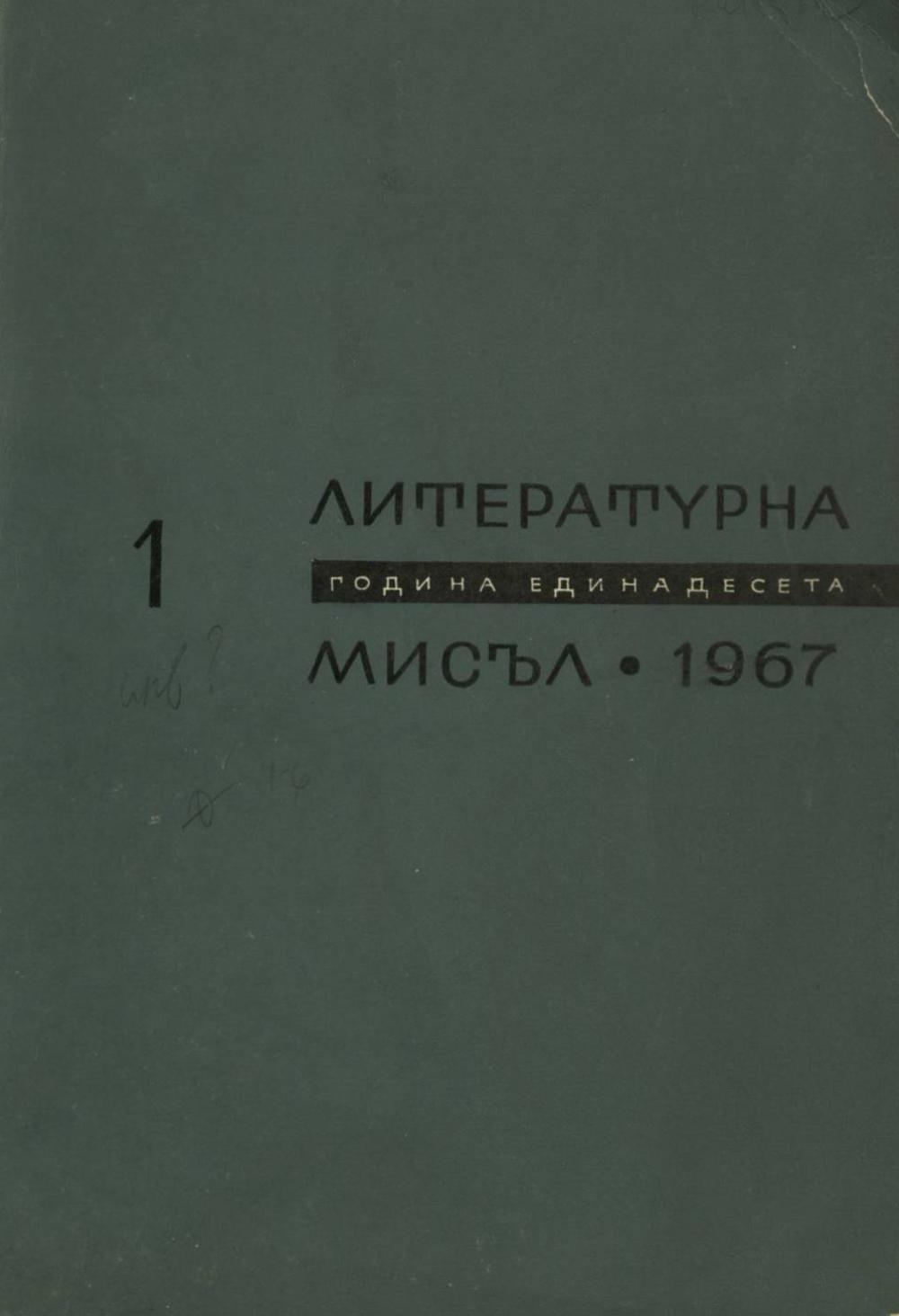
-
ДВУМЕСЕЧНО СПИСАНИЕ ЗА ЕСТЕТИКА, ЛИТЕРАТУРНА ИСТОРИЯ И КРИТИКА
-
PublisherПечатница на Държавното военно издателство при МНО
-
ISSN (online)1314-9237
-
ISSN (print)0324-0495
-
Pages175
-
Format700x1000/16
-
StatusАктивен
Literaturna misal Contents
Free access
-
Summary/Abstract
Summary1967 Book 1 ContentsKeywords: Съдържание
Nikola Nikolov The ballad in the work of Pencho Slaveykov
Free access
-
Summary/Abstract
SummaryPencho Slaveykov is the most prominent representative of the Bulgarian ballad from the Liberation to the beginning of the present century. Above the few and unknown poets who tried to work in this field, he rises above both the number of ballads written and their artistic achievements. The lasting interest in folk art - an indispensable school for developing aesthetic taste - which Pencho Slaveykov maintained until the end of his life; the revolutionary struggles of our people, from which he took the themes of many of his works; his contact with European literature facilitated Slaveykov's aspiration to create poetry that reached the world level, without affecting its national peculiarity. This path of development turned out to be extremely fruitful and left a unique originality in his ballads.Keywords: Баладата, творчеството, Пенчо, Славейков
Atanas Natev Drama and screenplay
Free access
-
Summary/Abstract
SummaryIt is obvious that the latest structural trends in cinematography cannot be defined without comparing them with similar trends in literature. Leaving aside narrowly professional passions (the greater the more dubious the novelty of an artistic phenomenon), the so-called "author's film" of recent times makes the question of whether the prior literary discovery of the image is a condition and - if so - to what extent it could retain its literary character in its cinematic reproduction once again relevant.Keywords: драма, киносценарий
Simeon Hadzhikosev Bulgarian Symbolism and the Influence of the French Symbolists on It
Free access
-
Summary/Abstract
SummarySymbolism still remains one of the most unexplored areas of our literary history. The reasons for this are many and of the most diverse nature. Bourgeois science cannot embrace this phenomenon in perspective and retrospectively - it lacked the historical distance, and its very approach could hardly ensure the desired success. In the period of the cult of personality, the inertia of crude sociological simplistic thinking for a long time kept our literary science captive to the setting, the essence of which was reduced to the statement that symbolism was one of the ideological disguises of the reactionary bourgeoisie. Alleged vices were exposed, real and undeniable virtues were kept silent. And since there was a time when exposing the openly reactionary in science and art was considered almost an outdated taste, and the arrows in our criticism were aimed at "disguised" idealism, "disguised" fideism, etc., then it seemed fashionable to criticize symbolism as well.Keywords: Българският, символизъм, влиянието, Френските, символисти, върху, него
Docho Lekov Bulgarian translated fiction and “Bulgarization” during the Bulgarian Renaissance
Free access
-
Summary/Abstract
SummaryTranslated fiction in Bulgaria reflects in its own way the ideological and cultural peculiarities of the time, the taste and preferences of the reader. The content is one thing in the Middle Ages, when the newly adopted Christian religion had to be sanctioned, and its appearance during the era of national revival is another. However, its character changes relatively slowly, just as the worldview of the people also changes slowly... The economic changes in the Turkish Empire at the end of the 18th and the beginning of the 19th centuries lead to changes in the worldview, ideology and culture. Initially, they are imperceptible, manifest themselves unevenly, often developing in their old forms. However, they always become established - sometimes decisively and quickly, in other cases gradually and painfully. The new elements in the consciousness and psychology of the Bulgarian also require new literature - with themes, ideas and imagery, different from the literature of the Middle Ages. Indeed, in Old Bulgarian literature and in the Damascenes there are individual moments with secular content, with a view to the intimate world of man. However, these are only elements that had to be further developed and enriched, to be subordinated to the new concepts of the time. In this regard, a significant role is played not only by writers, but also by translators. Bulgarian writers understand the need for translated literature - be it artistic, pedagogical or social. This applies especially to the first decades of the Revival, when we did not have a significant original contribution in the field of national culture. Therefore, Revival writers perceive translated literature as an integral part of national literature. In this sense, the ideological and artistic principles that face the original creator are no less of a concern for every cultural translator.Keywords: българската, преводна, белетристика, побългаряването, през, Възраждането
Chavdar Dobrev Some problems of realism in Vakhtangov's art
Free access
-
Summary/Abstract
SummaryVakhtangov as a fully developed artist with his own concept of the art of theater can be spoken of mainly in connection with his two last masterpieces - "Khadibuk" by A. N. and "Turandot" by K. Gotsi. Here he already reveals his understanding of the tasks of the new Soviet art, of the place of the director and the actor in it, of the relationship between the playwright and the theater, of the need to reach new social and psychological depths. It is quite natural that with these productions Vakhtangov managed to immortalize himself, to remain a symbol of a unified theatrical revolution, of a renaissance in Soviet art. Therefore, it is precisely these two performances that give us the right to examine in a generalized manner a number of more general questions of the art of theater, closely related to modernity.Keywords: някои, Проблеми, реализма, Изкуството, Вахтангов
Lyuben Georgiev Young poets. Parvan Stefanov. Hristo Fotev
Free access
-
Summary/Abstract
SummaryI will not talk about the poems of Parvan Stefanov, written before 1956 and not included in his first book - as is known, out of the numerous songs of enthusiasm, he included in "Falcon Feathers" only one soldier's cycle. Therefore, I will say that he started from a relatively high level. To begin with, I will take his first poems from the newspaper "Narodna Mlazed" (1949), his first book, which appeared in 1956. It was a time when he was one of the most popular young poets. His poem "The Stone Boy" (in Russian translation) received the prize of the Fifth World Festival of Youth and Students in 1955, it was read and copied, recited on every occasion, and the 24-year-old author left for Warsaw, from where he brought a notebook of poems and a love for Chopin's homeland, to whose fate and poetry he would permanently join. I say this because it is impossible to explain the entire subsequent development of Parvan Stefanov without the beneficial impact of his Polish meetings and experiences, predetermined by the happy decision of the festival jury. What made "The Stone Boy" appeal to the members of the jury and especially to its chairman - the prominent Turkish poet Nazum Hikmet? If we now read the collection "Falcon Feathers", we will find other, more mature poems, such as "Accident", "The Dance of the Negro" (it enjoyed success in literary readings), "Grass", "Ballad of the Three Fir Trees". Only now would it be the turn of "The Stone Boy" - it modestly takes its place among the good poems of the young poet. At that time, it bribed with its pure romance, connecting our dreams of today with the ideals of those who gave their young lives in the struggle. The concluding verse, revealing the true possibilities of the poet, has a special power:Keywords: Млади, поети, Първан, Стефанов, Христо, Фотев
Literaturna misal Emilian Stanev, 60 years old
Free access
-
Summary/Abstract
SummaryHere is a sixtieth anniversary that surprised many. Not that sixty years is a long time, but Emilian Stanev's vitality and cheerfulness can rightly be envied by both forty and thirty-year-olds. Everyone who has had the opportunity to meet and talk to him has been amazed not only by his appearance, his lush black, unscented hair, his always cheerful movements, but also by his extremely mobile and restless thought, his turbulent imagination, his extraordinary spiritual energy. Emilian. Stanev is not among the most prolific writers, but it is difficult to imagine another writer who is so constantly busy with his work: not only in his office, but also on the street, in the garden, in the club, in a circle of friends - everywhere. He seems unable to survive a single day without thinking and talking about art, about his work. And despite the great preliminary work of the mind and imagination, what an impressive amount of paper Emilian Stanev writes for each chapter of his works. His critical, weighing thought is vigilant at its post, demanding new and new revisions. He is tireless in his pursuit of perfection, he is dedicated and selfless as a creator, both young and old can take an example from him.Keywords: Емилиян, Станев, години
Teodosiy Anastasov Berkovo events and figures in Vazov's work
Free access
-
Summary/Abstract
SummaryHaving hidden the order under No. 145 of February 23, 1879 of the Office of the Russian Imperial Commissioner in the pocket of his uniform as a state councilor, "the junior clerk for special orders at the Ruse governorship, Ivan Vazov boarded the Austro-Hungarian passenger steamer "Tegetov" on March 6 of this year in the afternoon and early the next morning arrived at the port of Lom-palanka, bustling with cars and people and crammed with goods. From here, Vazov rented a carriage and that same evening arrived in Berkovitsa, where he took up the position of chairman of the district court.Keywords: Берковски, събития, лица, творчеството, Вазов
Literaturna misal Minko Nikolov
Free access
-
Summary/Abstract
SummaryFor the first time, our magazine encloses the name of its editor in a mourning frame. Tragic circumstances dictated that this should be the name of the youngest member of the management of "Literary Thought", who with unusual conscientiousness and skill contributed to the development of the magazine for years. For all of us who shared our workdays with him, it was unbearably hard to lose the person on whose responsiveness and principle we had always relied so much. But even heavier is the loss for Bulgarian literary knowledge, of which Minko Nikolov was the most significant hope. Born in 1929 in the vibrant mountain town of Troyan, Minko Nikolov showed his literary talents at a very early age. At first, readers are introduced to the enthusiastic, somewhat clumsy, but completely in tune with his time and age poems of the provincial youth, who later, during the first years of his studies at the Philological Faculty of Sofia University, also showed his true gift - the rare gift of a literary critic and researcher. When in 1955 Minko Nikolov stood at the desk to defend his PhD thesis on the work of Hristo Smirnenski, he was already an established scholar with enviable achievements for his age. Years of hard and fruitful work followed for him as an editor, associate professor of Bulgarian literature at the Humboldt University - Berlin and senior research associate at the Institute of Literature of the Bulgarian Academy of Sciences. The years during which Minko Nikolov attained his creative maturity coincided with the time in which our literary studies, having shaken off the petty tutelage of dogmatism and administrativeism, took its first not very big, but decisive steps forward towards the actual scientific understanding of our national literary experience. And when we ask ourselves how the younger generation of literary critics and researchers helped to achieve the success of these renewal efforts, our answer will refer first and foremost to the creative work of Minko Nikolov. An inexplicable death for us took him away on the eve of the New Year, when people are so indulgent towards their hopes. It took him away from ours when it needed him most.Keywords: Минко, Николов
Hristo Yordanov Radichkov's Siberian campaign and the golden idol of the North
Free access
-
Summary/Abstract
SummaryMuch light and beauty have radiated from the insatiable eyes of Yordan Radichkov to illuminate and bathe in brilliance his unlit Courtyards. Much warmth and tenderness have radiated from his heart to warm our souls with thought and poetic imagery; to enrich and invigorate them with his pure love for ordinary Soviet people and to make us deeply empathize with his Siberian unrest. His restless feelings, reflections and experiences strike us, just as the imagination is struck by the vastness of the dead Siberian fields, the snowy wasteland of the tundra or the taiga of Yakutia; just as the mind is struck by gold, huge pieces of gold nugget or the bright shine of diamonds from the Yakut deposits; just as the soul is saturated by the wondrous beauty of the northern lights, the breath of the Arctic Ocean, the charm of Lake Baikal or the lush virginity of the Altai Mountains. Years ago Yordan Radichkov toured the lands of his homeland on foot. He warmed the hearts of young workers with news of their beautiful impulses. Later he discovered his beloved Arcadia, where he settled the people he met in his native land. Then he crossed Europe. He drank coffee on the Champs Elysees, his shadow wandered by the Eiffel Tower or Notre Dame. He listened to Ave Maria in Rome. He walked along the seaside boulevards of Cannes.Keywords: Сибирският, поход, Радичков, златният, идол, Севера
Marina Karadzhova-Popova The first novel by Blaga Dimitrova
Free access
-
Summary/Abstract
SummaryHaving shown her poetic talent in several poetry collections, Blaga Dimitrova entered fiction with the novel "Journey to Yourself". Her creative powers received a boost from the turning point - September 9, 1944, which coincided with her youth. She enthusiastically joined the general construction - she participated in the foreman movement, and in 1952-53, she spent almost two years on construction sites in the Rhodope Mountains. Her creativity is a living echo of what she saw and experienced. Her novel should not be considered in isolation from her poetry - it is organically connected to it. Construction and its characters are the subject of depiction in both poetry and the novel. This is especially true for the collection "Songs for the Rhodopes", which in a certain sense is a preparation for the novel. The same basic mood emanates from it - love for the fatherland and for man, faith in the future, admiration for the new people who create this future. It often contrasts the heavy and sad past, the historical fate of our people with the present, and even more so with the expected good future. In this collection, the prototypes of some of the characters in the novel can already be seen.Keywords: Първият, роман, Блага, Димитрова
Hristo Dudevski Study of Bulgarian Literature in the Soviet Union
Free access
-
Summary/Abstract
SummaryFreed from the postulates of comparativity, the problem of the reception of a particular literary work in one or several national literatures naturally took one of the leading places in the interests of contemporary Marxist literary scholars. It could not be otherwise. After Marxism-Leninism permeated and enriched literary studies with its methodology and thereby turned it into an objective science, it became clear that the history of any national literature can be scientifically correctly presented and aesthetically truthfully revealed only when it is studied in connection with the history of other countries and peoples and their literatures, when the mutual connections and influences are clarified. Why? Because nothing else but the general, similar laws of historical development, which for each people (and each historical period) have their own, specific features, are the basis on which a given literary trend and influence grows and develops. This dependence was established by G. V. Plekhanov, who wrote that the influence of a given literature from one country on the literature of another is directly proportional to the similarity of the social relations of these countries.Keywords: изучаване, българската, литература, Съветския, съюз
Stefana Tarinska New data on the creative biography of Lyuben Karavelov
Free access
-
Summary/Abstract
SummaryLyuben Karavelov is one of the few Bulgarian nationalists who collected and carefully preserved documents about his diverse social and writing activities. Unfortunately, his uncertain emigrant fate, and after his death - irresponsibility and negligence, became the reason for the dispersion and, for the most part, destruction of this Karavelov collection, so valuable for the history of our cultural life. Little and mostly fragmentary materials have reached us - heart-wrenching fragments of a rich and multifaceted comprehensive work. The preserved manuscripts from Karavelov's archive are today kept in the Bulgarian Historical Archive at the Cyril and Methodius National Library and in the Boyan Penev Archive at the Bulgarian Academy of Sciences. Difficult to read, they have remained almost unused to this day. It was not until 1964 that three collaborators from the Institute of Literature - Docho Lekov, Lilyana Minkova and Tsveta Undzhieva - published the most significant of them in one solid volume: "From the Archive of Lyuben Karavelov. Manuscripts, Materials and Documents". The publication includes primarily Karavelov's manuscripts and some manuscripts of his collaborators, closely related to the writings of Karavelov himself. Abandoned are copies of foreign artistic or scientific works, known translations of his, or manuscripts of his famous works. The compilers present us with a volume composed almost entirely of new materials, reflecting the diverse creative activity of the great Bulgarian Renaissance public figure and writer.Keywords: Нови, данни, творческата, биография, Любен, Каравелов
Literaturna misal *** From the report of the Institute of Literature on its work in 1966.
Free access
-
Summary/Abstract
SummaryIn 1966, the Institute of Literature was working on the following problems: History of Bulgarian Literature - a comprehensive work on the development of Bulgarian literature from the 9th century to the present day. The work is being worked on by a wide team. This year, volume 11 was printed, covering the historical development of Bulgarian literature during the Renaissance. Volume III - Bulgarian literature from the Liberation of Bulgaria to the end of the First World War - was also completed and discussed by the team of authors. It is about to be reproduced and widely discussed. Work is also underway on writing volume IV, which will be completed in 1967.Keywords: отчетния, доклад, Института, литература, работата, през
Literaturna misal *** New scientific work for Kiril Hristov
Free access
-
Summary/Abstract
SummaryAt the end of last year, the Scientific Council of the Institute of Literature at the Bulgarian Academy of Sciences discussed and accepted for publication the work of Acad. Mihail Arnaudov "Kiril Hristov. The Man and the Poet". In his review, Krastyo Genov highlighted the merit of Mihail Arnaudov in tracing every step of the life and work of Kiril Hristov: a difficult and responsible task in revealing the sharp contradictions in the poet's creative biography. The author selects what is truly important and significant in the work and in the difficult life of the poet, bypassing the erroneous, inaccurate and artistically petty. He correctly identifies the individual traits of the personality and the creator, achieving an objective and convincing assessment of a life filled with contradictions of an ideological and moral nature, with torment and dissatisfaction. The monograph is particularly valuable with the rich factual material skillfully used by the author. He managed to present a broad picture of social reality and literary mores, including personal memories, observations, and excerpts from his interesting correspondence with the writer.Keywords: Научен, труд, Кирил, Христов
Literaturna misal *** “Problems of Realism in Bulgarian Fiction during the Revival” by Docho Lekov. [Candidate's Dissertation]
Free access
-
Summary/Abstract
SummaryIn the last quarter of 1966, the Scientific Council of the Institute of Literature at the Bulgarian Academy of Sciences decided to award the scientific degree "Candidate of Philological Sciences" to the regular graduate students at the institute, Stefana Tarinska and Docho Lekov.Keywords: Проблеми, реализма, българската, белетристика, през, Възраждането, Дочо, Леков, Кандидатска, дисертация
Literaturna misal *** “The Prose of Hristo Botev” by Stefana Tarinska. [Candidate's Dissertation]
Free access
-
Summary/Abstract
SummaryIn their written reviews, Prof. Georgi Tsanev and Assoc. Prof. Ivan Undzhiev made a detailed analysis of St. Tarinska's dissertation work, focusing primarily on the new things she brings to the topic. Stoyan Karolev, Petko Totev and Pantelei Zarev took part in the discussion of the dissertation. They emphasized the originality of the study. The author attempts to reveal Botev's journalism from its artistic side, points out the aesthetic value of Botev's prose, and acquaints the reader with his poetics. The work traces the feuilleton as a literary genre of the modern era, highlights Botev's mastery of composing and fabulating, and indicates his great skill in using the various forms of artistic journalism. Tarinska also has interesting observations about the internal movement, the internal dynamics of Botev's thought, of Botev's speech, which especially contributes to the emotional impact of Botev's journalism. The author emphasizes the polyphonic nature of Botev's feuilleton, studied as an artistic-journalistic entity not only literary-historically, but also literary-theoretically. The work clarifies a number of questions about the nature of Botev's prose, its appearance in intellectual and emotional terms, and this makes Tarinska's work an original phenomenon, a contribution to our literary science.Keywords: прозата, Христо, Ботев, Стефана, Таринска, Кандидатска, дисертация