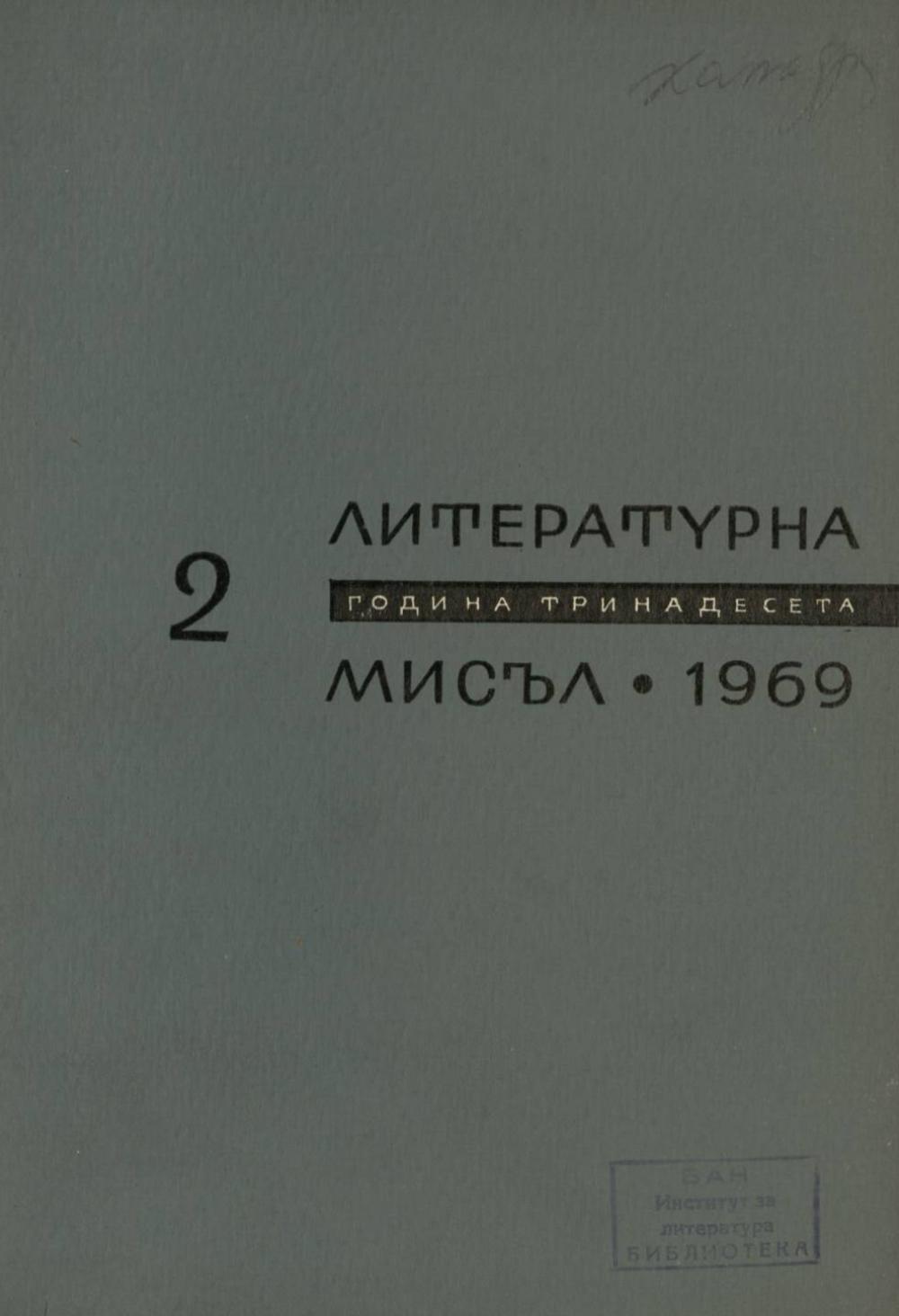
-
ДВУМЕСЕЧНО СПИСАНИЕ ЗА ЕСТЕТИКА, ЛИТЕРАТУРНА ИСТОРИЯ И КРИТИКА
-
PublisherПечатница на Държавното военно издателство при МНО
-
ISSN (online)1314-9237
-
ISSN (print)0324-0495
-
Pages200
-
Format700x1000/16
-
StatusАктивен

Literaturna misal Contents
Free access
-
Summary/Abstract
Summary1969 Book 2 ContentsKeywords: Съдържание
Literaturna misal * * * Literary criticism faces new challenges
Free access
-
Summary/Abstract
SummaryDr. Todor Zhivkov's new speech "Carry and raise our pure, holy and victorious banner even higher!", delivered on March 14, 1969 before the sixteenth reporting and election conference of the capital's organization of the DCMS, as well as all his speeches and reports, found a lively response among our entire public. It was perceived as a very timely party document, a logical continuation of the "theses" for creative work among the youth, as a vivid manifestation of exceptional care and complete trust in the youth of the homeland and in the artistic intelligentsia, which was particularly moved by the fact that the main part of the speech was devoted to current problems related to the current state of the ideological front. This remarkable speech once again emphasizes the need to raise the role of social sciences and ideological disciplines, which are gaining in importance today, when a fierce battle is being waged between communist and bourgeois ideology to win the minds and hearts of people all over the world. That is why the party's call to young communists to take up the proud banner of Dimitar Blagoev and Georgi Dimitrov in their own hands, to raise it even higher and to carry it pure, holy, victoriously - through all trials and difficulties is so categorical.Keywords: литературната, критика, пред, Нови, задачи
Stoyan Iliev Laboratory for Contemporary Thinking
Free access
-
Summary/Abstract
SummaryIf we now start to claim that poetry lags behind life, it is like repeating something that has often been said. The idea that it lags behind modern life is not new - this idea, it seems to me, has existed since. as poetry itself has existed. We simply need to understand that the coefficient of selectivity in poetry is incomparably higher than, say, in prose. It is not by chance that Anatole France ironized the readers of poetry - with songs, he says, the case is the same as with women: the most beloved is always the best of all the others.Keywords: лаборатория, Съвременно, мислене
Kuyo Kuev On some issues of Old Bulgarian literature
Free access
-
Summary/Abstract
SummaryOver the past ten years, interest in the issues of Old Bulgarian literature has grown significantly, both among our own and among some foreign scholars. In the first place among foreigners in this regard are the Soviet medievalists D. S. Likhachev,1 I. P. Eryomin,2 Yu. K. Begunov, N. K. Gudziy, M. V. Shchenkina, who in a number of their works shed light on one or another fact of our old literature, express one or another assessment of the phenomena, etc. Following the example of their predecessors - the old Russian Slavists and experts on Old Bulgarian literature - they strive to study the facts well, to systematize them and, on the basis of all this, to draw the appropriate conclusions and inferences. This approach to the phenomena of the development of Old Bulgarian literature is completely correct and leads to positive results. Therefore, the mentioned Soviet scholars can also boast of valuable achievements.Keywords: някои, въпроси, старобългарската, литература
Krastyo Kuyumdzhiev Notes on the anthology "Old Bulgarian Pages"
Free access
-
Summary/Abstract
SummaryAs often happens in the history of our new culture, we are in a paradoxical situation: we declare ourselves the heirs of the classical Bulgarian culture of the Middle Ages, the center of Slavic culture in general for certain historical periods, but we do not know it well. We are simply proud of the alphabet and old literature, we use catchphrases to prove that in the history of human culture we did not exist yesterday, and in our veins there is something of the blue blood of ancient cultural dynasties. But what do we know about Old Bulgarian literature? At school we learned about Presbyter Kozma, who "delivered some kind of discourse against the Bogomils (he was a reactionary and an obscurantist, because the Bogomils are progressive), and about Chernorizets Hrabar (he wrote something about the features and letters). Scientists argue about him whether he was not Tsar Simeon (this somewhat influenced our imagination - a great king, brilliant like Solomon, ruler of nations, but he puts on black hair and writes some writings in dark cells!). But in general, there is hardly a more boring subject at school. At university we learn the conjugations of verbs, we even try to spell the letters from some gospel (those terrible letters!). That is, so to speak, all our education on Old Bulgarian literature. We are so uninterested in it that we have even thrown out everything that reminds us of the Old Bulgarian language from spelling and orthography. We want to say, what do we care about various Nosovk and Ierov, there is no such thing in our modern language, let's leave them to the priests and philologists; our culture is folk, democratic, everyone should have easy access to it, it would be a manifestation of conservatism to treat a dead language and incomprehensible letters with care, even if our own history is reflected in this language and these letters!Keywords: Бележки, върху, антологията, старобългарски, страници
Stoyko Bozhkov G. P. Stamatov
Free access
-
Summary/Abstract
SummaryMany still remember his soldierly figure: in winter with a black coat and a black soft hat, in summer - always with a white jacket, an open a la Byron shirt, dark blue trousers and a white straw hat. In bad weather, an umbrella hangs from his elbow. Most often, in one hand hangs a net in which he takes home a loaf of bread or biscuits. He was usually thoughtful, absorbed in himself. His eyes were lost under thick eyebrows. But when they focused on someone - they did deep dissections, doubted everything, looked for secrets and truths. Concentration did not prevent him from being polite to every acquaintance he met. If not with a joke, with a touch of two fingers to the brim of his hat - he greeted them politely. Even children! An expression of attentive attitude towards a person, a sign of a lively attitude towards the world around him! And outwardly he looked gloomy, indifferent, even proud and haughty towards everything around him. He rarely walked the streets. Usually he passed them to go to an acquaintance for a conversation or to some of the capital's cafes. In his last years, he especially often stayed in the editorial office of "Vestnik na zhenata" or with Nikolay Liliev at the National Theater.Keywords: Стаматов
Efrem Karanfilov Emilian Stanev – nature artist
Free access
-
Summary/Abstract
SummaryBy the place that nature occupies in the work of a writer, we can reveal not only essential features of his appearance, but also some directions in the spiritual life of the era. There are authors who are insensitive to natural beauties. They are able to pass by a dazzlingly beautiful Alpine peak without interrupting their intellectual conversation, like the old Erasmus, or, standing in front of Niagara Falls, admire its energy more than its beauty, like the modern Steinbeck. We must not forget that writers from different schools and trends, as well as artists with different personalities, describe nature in different ways. The Romantics, for example, devoted a large place in their work to the delights of natural beauties. But how different are the hazy paintings of Chateaubriand - a dreamer and a contemplator - compared to the harsh, precise and strong descriptions of the officer Alfred de Vigny. Prishvin and Bianchi are almost contemporaries. But the lyrical excitement and confessions of the one are replaced by the bright, clear, full of philosophical generalizations of the other.Keywords: Емилиян, Станев, Художник, природата
Zdravko Petrov The critical drama of life
Free access
-
Summary/Abstract
SummaryDuring his lifetime, no literature was created around him, no scandalous noise was raised, and yet he was at the forefront of the Bulgarian intellectual process. It's not that he wasn't written about (on the contrary, his publications were always met with enthusiastic reception and laudatory reviews in the press), but he didn't like to impose his silhouette. Minko Nikolov had an innate dislike for scandalous fame and noisy appearances in literature. But his insufficient "noticing" was to some extent hindered by the innate myopia of his contemporaries. Many things prevented us from seeing him in his true stature. And here we involuntarily fell into the position of Chekhov's heroine, who had dreamed all her life of seeing the extraordinary man, and he was there for her. The daily routine, the controversial nature of the controversial profession - criticism (or as some writers call it, the "strange profession") prevented us from seeing him in his true scale, from taking into account the seriousness of his intellectual drama. This drama became deeper and deeper day by day, to reach the fatal denouement of the end of December 1966. It was only the black silhouette of the suicide bomber that forced upon the living in an inimitable way the magnitude of the life drama called Minko Nikolov. And now we see in the light of "what has happened" the irreversible, the terrifying. "Nothing, that many ridiculous life circumstances prevented us from seeing behind his kind smile the already maturing skeptical, hopeless smile, which often adorned his spiritualized face. And no matter how much we stared and were insightful, we could not discover the depth of his human tragedy. And he had already been carrying it for years, silently and imperceptibly, like some kind of "sarcoma" that torments the brain, takes away the energy of his nerves, the juice of his human and social enthusiasm. She was, with a kind of malicious pace, preparing the sudden catastrophe, the "cruel collapse" of a valuable and long-built creative personality.Keywords: Мисловната, житейска, драма, критика
Simeon Hadzhikosev Towards the issues of Bulgarian symbolism in view of its comparability with Russian symbolist trends
Free access
-
Summary/Abstract
SummaryA necessity for our literary science is the combination of the sociological, psychological and aesthetic-philosophical principles in the literary-theoretical problematic, so that it can emerge from the role of a simple companion of the literary process and take its rightful place as a generalizing and guiding force. In this sense, the relapses from journalism and the template in literary-theoretical and critical work must be condemned, the danger of essayism as a scientific approach and the risk associated with modern formalistic and experimental methods must be highlighted. An illustration of these thoughts, expressed by Acad. Pantelei Zarev in his speech before the First Congress of Bulgarian Writers, is the theoretical-historical model of our literature from before the Liberation to the First World War, proposed by him in his book "Panorama of Bulgarian Literature". Through it, he not only makes a deeply justified characterization of the concepts of "national destiny" and "national character", as well as of their dialectical interrelation and unity with our literature, but also brings out his thought about the originality of our historical national existence and the literature associated with it. "The decisive thing in our ideological existence - writes P. Zarev - were not the influences, strong and even stimulating in themselves, but the pressure of hidden forces, moral, psychological and socio-historical. The grain grows on its soil, draws its juices from it, leaves its fruit in it. Such is the original fate of the writer. Naturally, our national destiny weighs on him, even when the separation from the generic begins, when the phenomena contrasting with the past and the raging forces of individualism are already emerging. This is precisely what provides the grounds for a literary-historical logic, for a nationalKeywords: проблематиката, българския, символизъм, оглед, съпоставимостта, руски, символистични, насоки
Todor Iv. Zhivkov Ст. Стойкова Tsvetana Romanska
Free access
-
Summary/Abstract
SummaryProf. Tsvetana Romanska has left us. Her early and unexpected death seems incredible to those who knew her - always so lively, active, always busy, cheerful and proverbially hardworking. We have lost a prominent Bulgarian ethnographer and folklorist, who devoted her entire life to science, a responsive comrade and teacher, who until yesterday captivated us with her creative plans. Prof. Romanska worked for thirty years in the field of ethnography and folklore. Born in 1914 in the family of our famous scientist Acad. St. Romanski, received excellent training, and early on she oriented herself towards scientific work. After graduating in Slavic philology at the Faculty of History and Philology of Sofia University, she went to specialize in Prague, where in 1939 she defended her doctoral dissertation and became a doctor of Charles University. Returning to her homeland, she was elected assistant and later associate professor at the Department of Slavic Linguistics and Ethnography. Since 1963, she has been a professor of Slavic Ethnography and Slavic Folklore - a very extensive field in which she works tirelessly and with great desire.Keywords: Цветана, Романска
Nikolay Donchev Meetings and conversations in Paris
Free access
-
Summary/Abstract
SummaryChoosing November to stay in Paris has, on the one hand, the convenience that cultural life has already begun there, people are in their places, theaters and various institutions related to science, literature, art are open; on the other hand, it is - in terms of weather - the most fickle month, at that - unpleasantly cool, unwelcoming, with fog and rain that ties one hand to the umbrella, while with the other you have to clutch under your arm the bag with the address book, with all sorts of notes, with one or another purchased book... The "metro" card should also be at hand, because, although the fares have increased, it still remains the most convenient and cheapest means of transport.Keywords: Срещи, разговори, Париж
Ante Kandich Horvat-Kish for Bulgaria. Travel notes from 1911.
Free access
-
Summary/Abstract
SummaryWhen Bulgaria was completely liberated in 1878, the Croats also exclaimed with joy and gradually began to come to the liberated land as artists, teachers, merchants and tourists. A large number of Bulgarians, especially during the period between the two world wars, studied at the University of Zagreb, and many of them visited Croatia throughout our century. There are two main reasons for these mutual visits: first - the beauty of the two lands, second - the feeling of Slavic solidarity. The Croatian writer Franjo Horvat-Kiš (1876-1924) visited Bulgaria in mid-July 1911 and about this trip he left a very interesting but little-known travelogue entitled "Seen and Unseen", Zagreb, 1911. Since I, more than half a century after him, spent in Bulgaria not two days, like Horvat-Kiš, but three months, I would like to present to the readers Horvat's travel notes with a few of my explanations and additions. His and my attitude towards this sympathetic country is the same: objective, mixed with elements of sincere sympathy.Keywords: Хорват, България, Пътни, Бележки
Magdalena Shishkova In the world of prose – with insight and aesthetic sense. (Stoyan Karolev. In the world of prose)
Free access
-
Summary/Abstract
SummaryStoyan Karolev's new book "In the World of Prose" is one of the most meaningful events in our literary life in recent years. It can be passed over and underestimated only by someone who suffers from congenital aesthetic myopia or is gripped by attacks of progressive professional egocentrism. It reveals with utmost clarity the most joyful trends in the development of contemporary, dialectically enriched aesthetic thinking, capable of penetrating the specific spheres of verbal art, of discerning the uniqueness of various creative talents, of achieving the truth about the artistic completeness and functionality of various stylistic and genre phenomena, about the aesthetic existence of the individual work of art, of the artistic image and suggestion. "In the World of Prose" affirms the legitimate aspiration of today's literary researcher to enter the holy of holies" of authors and books without prejudice and pretense, without aesthetic ecstasy and "artistic exaltation," but with increased intellectual insight into real ideological and aesthetic values, with increased emotional responsiveness to the artistic atmosphere of literary facts. Indicative of the peculiar renaissance that many of the leading representatives of our theory and criticism have experienced in the last decade, this book also represents an event in the author's personal biography: it contains the happy fruits of an inspired creative maturity.Keywords: света, прозата, проницателност, естетически, усет, Стоян, Каролев, света, прозата
Lyubomir Buchkov New scientific work on Grigor Parlichev by Acad. M. Arnaudov
Free access
-
Summary/Abstract
SummaryAcademician Mikhail Arnaudov is one of the most inspired historians and interpreters of the Bulgarian Revival. In a number of monographs he builds in relief the images of selfless figures of this era, who saved Bulgarianness from melting. Among the most prominent figures of the Revival is Grigor Parlichev. A scientist, a post and an apostle of freedom with diverse activities - all his manifestations are the object of Arnaudov's scientific and literary interest. Grigor Parlichev is a true Bulgarian poet, "misunderstood", as Ivan Vazov puts it. His creativity and social activity have excited and will continue to excite Bulgarians. A fighter and creator, he directs his activities towards the affirmation of Bulgarian culture and its liberation from Ottoman slavery and Hellenization. 1 The newly published book about Grigor Parlichev is a new edition of the famous monograph by Mihail Arnaudov on the life and work of Grigor Parlichev, designated by the author as a "characteristic and notes" and a collection of Parlichev's works: "Autobiography", "The Serdar", translated into prose by Vasil Pundev, the poem "Skenderbey", a translation of the "Iliad", "The Dream of an Old Man" and illustrations. The following stanza by Ivan Vazov is set as the motto of the book:Keywords: Научен, труд, Григор, Пърличев, акад, Арнаудов
Tsveta Undzhieva New research and documents on the life and work of Hristo Botev
Free access
-
Summary/Abstract
SummaryThe Soviet scientist K. A. Poglubko continued for several years to research the Bulgarian-Russian revolutionary relations of the 1960s and 1970s. The result of his research are the interesting studies "Iz istorii Russko-Bulgarskikh revolutionarynyh syvyaz kontsa 60-kh ogode XIX c." (News of the Academy of Moldavian SSR, No. 1, 1965), "Some new materials about the connections of Russian revolutionaries with H. Botev in the early 1970s." (Izvestia AN Moldavskoi SSR, No. 2, 1966), "Connections of Bulgarian and Russian emigrants (1869)" (Izvestia AN Moldavskoi SSR, book 1, 1968) and others. The studios are interconnected. They are obviously key moments of a comprehensive monographic work that will shed new light on a remarkable heroic period of our national Revival and on the activities of the greatest figures of the era.Keywords: Нови, изследвания, документи, живота, делото, Христо, Ботев
Lazar Tsvetkov Love in Lermontov
Free access
-
Summary/Abstract
SummaryRecently, interest in Lermontov in the West has definitely grown. It cannot be compared with the campaign for Dostoevsky and Tolstoy, it is far from the feverish curiosity about Gogol, but it is already noticeable and emphasized enough. Lermontov is translated, read, here and there walks the theater ramp. People write and talk about him. Perhaps in this way the real significance of a great writer, comparatively less known to the Western intelligentsia, is being restored, perhaps the so-called "poet of disappointment" appeals to the fashionable decadent moods with his misinterpreted "spleen", with his deliberately accentuated and generalized dissatisfaction with life", with his clearly forced capitulation to the "demonic" forces of the world; Perhaps Lermontov is the last excavation of the modern "modern" from the unread antiquity "According to the established standard for the new as a well-forgotten old". There are many reasons for the resurrection of a great name. But, it seems to me, those listed so far do not explain an already long-standing interest, beyond simple snobbish fascinations.Keywords: Любовта, Лермонтов
Hristo Dudevski The Bulgarian monograph on Leo Tolstoy. (Georgi Konstantinov. L. N. Tolstoy and his influence in Bulgaria)
Free access
-
Summary/Abstract
SummaryRecently, the publishing house "Narodna Kultura" released a monograph on Lev Nikolaevich Tolstoy. The publication is a jubilee one - in August of this year, the entire cultural humanity solemnly celebrated the one hundred and fortieth anniversary of the writer's birth. Numerous articles and notes - original and translated - have been published in Bulgarian so far, starting from 1898, when the seventieth anniversary of Tolstoy's birth and fifty years of his literary activity were celebrated. I will recall the most significant of them - Dimitar Blagoev's review of the treatise "What is Art?" on the occasion of its Bulgarian edition in 1900, Petko Todorov's preface to Lev Tolstoy's brochure "The Times are Near", individual works by Vasil Kolarov, Vela Blagoeva, Georgi Bakalov, confessions and assessments by Ivan Vazov, Aleko Konstantinov, Stoyan Mihaylovski and others. All this and additional material collected by the author formed the basis of the monograph "L. N. Tolstoy and His Influence in Bulgaria". There is no doubt - this is the first comprehensive study by a Bulgarian literary critic on the life, literary work and philosophical-ethical ideas of the great sage from Yasnaya Polyana. Among the vast - both in size and in thought - critical literature on Tolstoy, Georgi Konstantinov's book will rank not least. Above all, it captivates and excites with the researcher's personal attitude to the many and often mutually exclusive problems and ideas that Tolstoy himself advocated during more than half a century of his most active and fruitful creative activity, and under whose pen so many amazing works of art were born.Keywords: българската, монография, Толстой, Георги, Константинов, Толстой, неговото, влияние, България