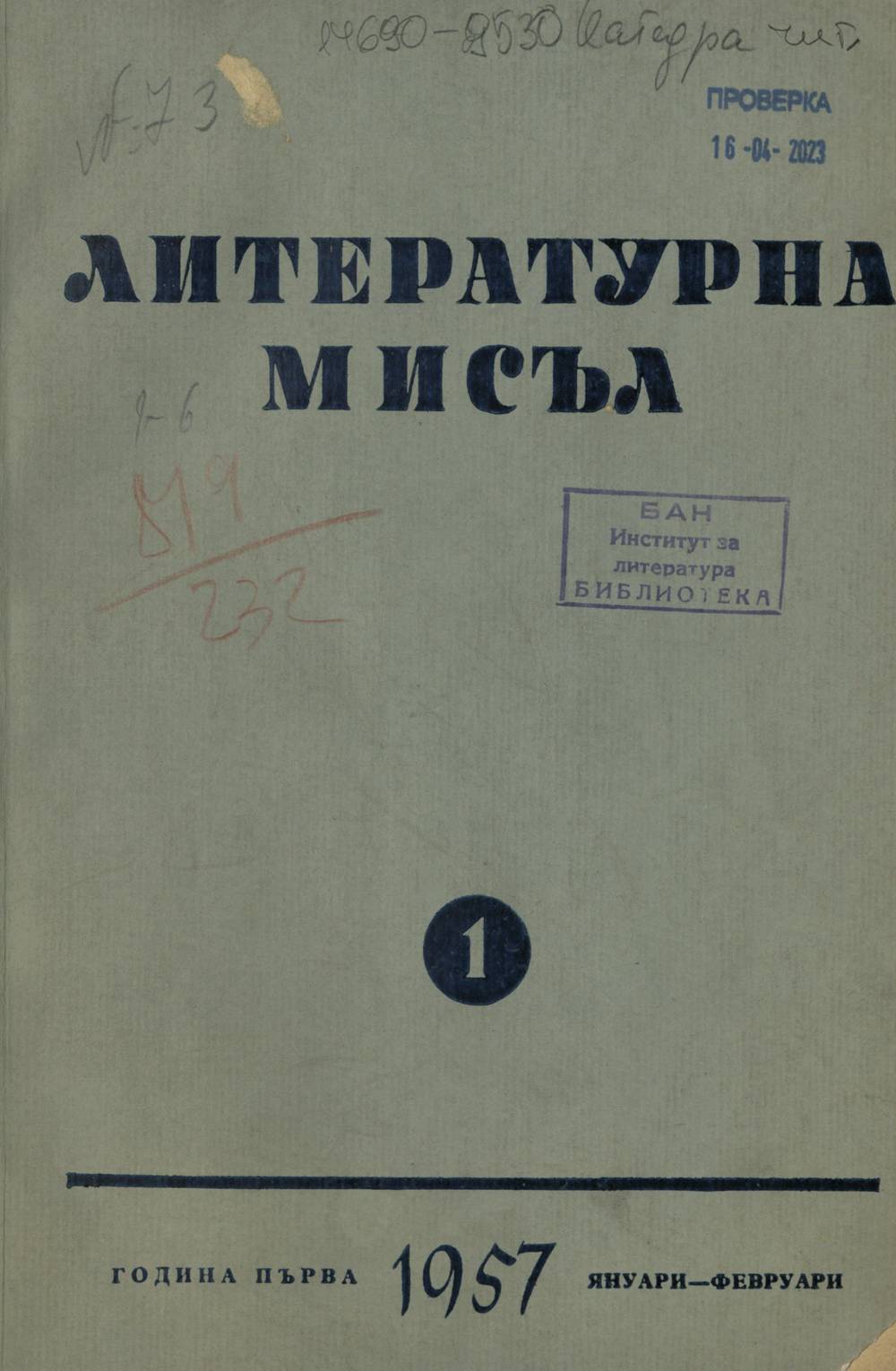
• Name:
    Stoyan Karolev
  • Inversion: Karolev, Stoyan

Free access
  • Summary/Abstract
    Summary
    This concerns the psychological characteristics of characters in fiction. For a long time, these issues were neglected by both critics and artists. But recently there has been a revival, mainly in fiction. This came naturally, as a reaction against the simplistic understanding of socialist realism. In the recent past, we often repeated that in order to artistically recreate contemporary life, which is in constant motion and transformation, it is necessary for characters to be depicted in motion, in action, and not as Oblomov in bed. And this, generally speaking, is indeed the case. But we often forgot the old truth that art is the study of human nature, i.e., that it deals primarily with the human soul. And if the fiction writer fails to open up the souls of his characters to his readers, if he is content to describe their actions empirically, if he skims over the surface of the events in which they participate, he will deviate from his artistic goals and tasks and even risk falling outside the boundaries of art. There are many who have indeed found themselves there with some of their works. And after they got stuck, they began to remember the old truth.
    Keywords: въпроси, психологическата, характеристика
Free access
  • Summary/Abstract
    Summary
    Literature reflects life in a more multifaceted and profound way, the brighter the creative individuals working in it - with rich life experience, with a penetrating ideological outlook, with a unique way of artistic perception and depiction. Without the creative self-image of individual authors, the artistic wealth of literature as a whole is unthinkable. Reality is infinitely diverse. It is, according to Dostoevsky, both unexpected and fantastic, and sometimes even incredible. (Russian Writers on Literary Work. Leningrad, 1955, vol. III, p. 151). It seems to me that these words are especially suitable for our contemporary reality, with the miraculous transformations that take place in it. And what a deep meaning, what beauty in this vital "fantasy" of ours. As long as the writer knows how to penetrate it.
    Keywords: Творческо, своеобразие, художествено, богатство

Free access
  • Summary/Abstract
    Summary
    The first to encounter his name in print were the readers of the magazine "Savremennost" in the autumn of 1906. The magazine was rather nondescript. Its loud name was probably chosen to remind us that the editors St. Donchev and G. Savchev, whom no one knows today, had the "new literary trends" at heart, i.e., symbolism. At that time, in the minds of some intelligentsia, susceptible to literary fashion, decadence was a sign of modernity. But in the cycle "Dedication" by the new poet Dimcho Debelyanov, there is no decadent "modernity" to be seen. The poems are not shrouded in a symbolic fog, they are clear, traditional". "The inspirations come from elsewhere - from the poet whose personality fills the young man's heart with adoration - Pencho Slaveykov. At that time, Dimcho Debelyanov, born in 1887, was nineteen years old. He had just graduated from the first Sofia male gymnasium. In the gymnasium, he earned a reputation as a warm-hearted and talented young man. Many loved him - for his bribing immediacy, although he was also inclined to solitude, for his directness, for the pure fervor with which he spoke and declaimed. One of his speeches on the feast of Cyril and Methodius was long remembered. He made an even deeper impression with his recitation in "Slavic Discourse" of Vazov's poem "Come and See Us". This time he even gained the attention of the monarch Prince Ferdinand himself, who had come to the solemn student matinee. And no wonder. Dimcho was not at all embarrassed by Coburg. Turning to him, he boldly threw the angry denunciations of the people's poet into his eyes:
    Keywords: Димчо, Дебелянов, Място, литературния, процес, естетически, позиции, романтизъм, творчеството

Free access
  • Summary/Abstract
    Summary
    There are sensitive natures who are no less excited than talented poets, but their excitement does not give rise to poetic ideas. It is not a question of the desire to compose, which can also overshadow those completely devoid of talent, but it is very distantly related to the artistic idea. In order for a poetic idea to arise, talent is needed. Talent, so to speak, is an innate mastery, the bearers of which must thank nature. And the greater the talent, the more condensed, more concentrated this potential mastery is. The young Pushkin wrote poems whose mastery would be envied by even great poets in their most mature creative age. Pushkin is a worldly genius. But our Smirnensky also created unfading poetic works in his early youth. By the way, he died almost a teenager, and amazes us with his poetic virtuosity. Another young man, Dimcho Debelyanov, created perfect poems before Smirnensky. Even earlier, the unknown Peyu Kracholov amazed such strict literary connoisseurs as Dr. K. Krastev and Pencho Slaveykov, who simply wondered how this boy from the backwater province managed to achieve such heights of poetic skill in "Calliope". And yet, poets usually do not write their most perfect works at the beginning of their creative path. And brilliant poets develop, acquire mastery through schooling from their great predecessors, through a lot of work, through enriching their life experience, etc. A poet is one - says Gogol - who is more capable than others of feeling the beauty of creation" ("Russian Writers on Literary Work", Leningrad, 1954, vol. I, p. 477). This feeling for the beauty of the world is undoubtedly strengthened in creative practice, which forces the poet to seek the beautiful, the wonderful in life and truthfully depict it, to sing it. The poet, like any artist, is gifted by nature with strong observation and impressionability. And they are sharpened in the process of work.
    Keywords: поетическа, идея, поетическо, изображение

Free access
  • Summary/Abstract
    Summary
    "A person without secrets is like a flower without a scent. The scent is the secret of the flower. My house also has its secrets." The beginning of the story "Sunday" - one of the last works of Yordan Radichkov. "A rooster crows all night, we all hear it, but in whose bathroom the rooster is - no one knows." Here is the first secret... It may disappoint a little the one whom the opening words have set in a too secretive mood. Through a cooling and intriguing irony at the same time, the writer seems to be in a hurry to warn us: do not expect anything extraordinary, nothing exceptional, no heroic or tragic deeds, no deep psychological secrets. And indeed, whoever expected them did not wait for them until the last page of the story, dotted with ordinary incidents and scenes in an ordinary residential building on an ordinary Sunday.
    Keywords: Талант, творчество

Free access
  • Summary/Abstract
    Summary
    All Marxist critics and writers are for both tradition and innovation in their dialectical unity, without which literary development is unthinkable. Differences and disputes arise in the interpretations of this unity and especially in the assessment of the traditional and the innovative in authors and works. This is natural, because here theoretical and literary culture, depth of thought, artistic flair, etc. have their say.
    Keywords: насърчаваме, творческите, търсения

Free access
  • Summary/Abstract
    Summary
    A short story with this title clearly reflects Emilian Stanev's view of life in nature, enduring features of his attitude to the world. Isn't it the key to the sources of his creative originality? There is nothing fairy-tale about the plot. On a moonless June night, a goldfinch sneaks into the nest of two finches, where the female warms her small, still naked offspring with her body. The bird wakes up and sees "the eyes of the little beast, which phosphoresced like two burning bluish-green abysses, but it continued to lie over the chicks, because a mother's love is stronger than death." Maybe this is a story about the power of a mother's love? No, only this restrained passage is dedicated to it. The author also describes the drama that unfolded, the death of the bird and its chicks with restraint: "Suddenly the golden eagle rushed forward, grabbed the nest in its paws, tore it off and fell with it onto a branch. There it sank its thin, needle-like teeth into the finch, which squealed. Then the little beast ate the bird and the naked chicks slowly, without rushing, as cats eat... Fed and already lazy, the golden eagle crawls into the hollow of the beech tree, where it falls asleep. "The beech leaves trembled soothingly, as if distant waters were rustling." Nothing unusual has happened, the June night is still as calm and beautiful, illuminated by the pale light of the stars. Even more beautiful is the morning when the forest awakens - endless and vast", the horizon is ablaze "with the advancing sunrise" and on the top of the huge beech, on its silvery bark, "fiery and orange spots" play. Its silky bosoms sway, in which the finch and her young perish at night. "Hirringly absorbing the sun's rays, the thousands of silky soft leaves trembled and rustled from top to bottom, as if the beech was laughing with joyful shivers..."
    Keywords: Емилиян, Станев

Free access
  • Summary/Abstract
    Summary
    During its turbulent and long life, which temporarily faded away during the wars and ended in the tragic year of 1923, the magazine "Novo Vreme" by Dimitar Blagoev invariably devoted a large space to the problems of art and especially fiction. Blagoev was deeply convinced that fiction is one of the best means for society's self-knowledge, that the influence it can exert on life is enormous. This conviction inspired him to tirelessly care for illuminating in "Novo Vreme" the problems of art and literature from a "socialist point of view", to lead a consistent struggle for realistic and progressive fiction.
    Keywords: естетическите, позиции, Ново, време

Free access
  • Summary/Abstract
    Summary
    "I am afraid of those comrades who, as soon as they start writing or speaking, see only the clear scheme of the external world and hostilely avoid the labyrinth of the soul." This is how the hero-narrator of the unfinished, recently published novel "Achilles' Heel" confesses to us. In these words, as well as in the entire first chapter - a kind of reflection, a philosophical-psychological essay, we clearly perceive the own voice and gaze of the writer, Dimitar Dimov. "Is it," the communist narrator further asks, "the richness, diversity, subtlety and depth of thoughts and feelings that the immense complexity and beauty of the external world awaken in us, some kind of heresy?" No, of course not. After all, it is precisely from this wealth of the soul that the fruits of material and spiritual labor spring.... Indeed, it is precisely in it that the possibilities of the new man who builds socialism lie hidden! The greatness in the soul of modern man is not in some steel (according to the famous expression) monolithicity and hardness, in the absence of shortcomings and contradictions. It comes not from some "guild decency" in his morality, but from the courage with which he faces the truth, from the heroic firmness with which he overcomes the difficulties around him and within himself. That is why we should not hide his weaknesses, his vices, we should not decorate his character with "trinkets."
    Keywords: Димитър, Димов

Free access
  • Summary/Abstract
    Summary
    For almost a year now, bookstores have been offering the importance that Velichko Valchev has for readers a new work on Ivan Vazov - the most voluminous in the already impressive literature on the national poet. The author, Velichko Valchev, is a well-known researcher of the life and work of Ivan Vazov. He has published about sixty studies, popularization articles, reviews of editions of his works, translations of Vazov's works abroad, productions of Vazov's plays, etc. about our most popular classic. In addition, he has edited the poet's works, written a preface to one or another edition. Special mention should be made of the valuable volume "Unpublished Letters" of Ivan Vazov, Selected", edited and commented on by Velichko Valchev and published by the Bulgarian Academy of Sciences. The book "Ivan Vazov. Life and Creative Path", written, as we learn from the preface, over a period of more than ten years, in a certain sense summarizes and completes the long-term studies and research of Velichko Valchev. In it, the author used, of course, not mechanically, much of what he had previously written about Vazov.
    Keywords: Една, Книга, Иван, Вазов, Величко, Вълчев, Иван, Вазов, жизнен, Творчески