-
MAGAZINE OF AESTHETICS, LITERARY HISTORY AND CRITICISM
-
PublisherPrinting house of the State Military Publishing House at the Ministry of National Defense
-
ISSN (online)1314-9237
-
ISSN (print)0324-0495
-
Circulation50000
-
Pages129
-
Format700x1000/16
-
StatusActive
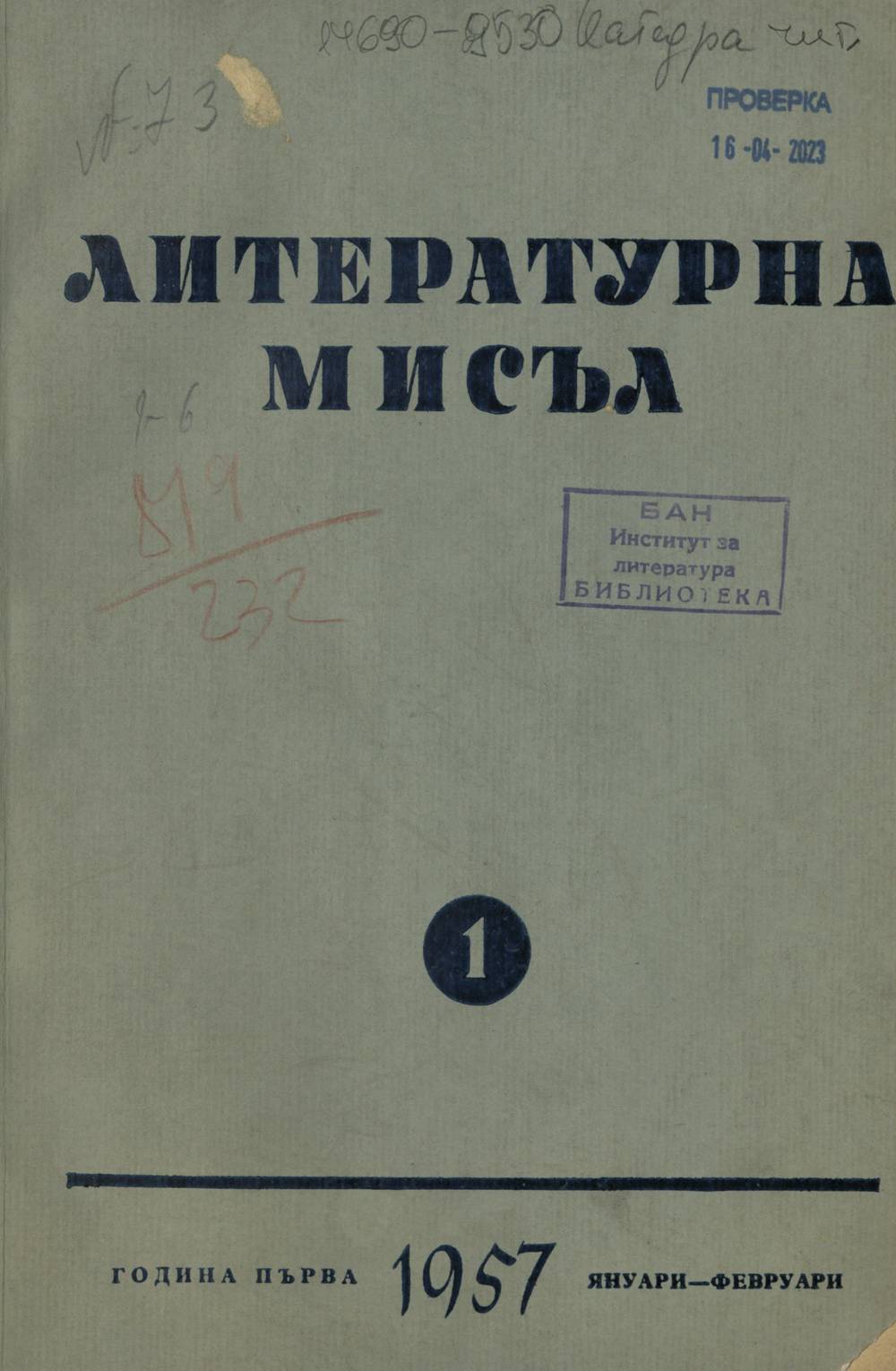
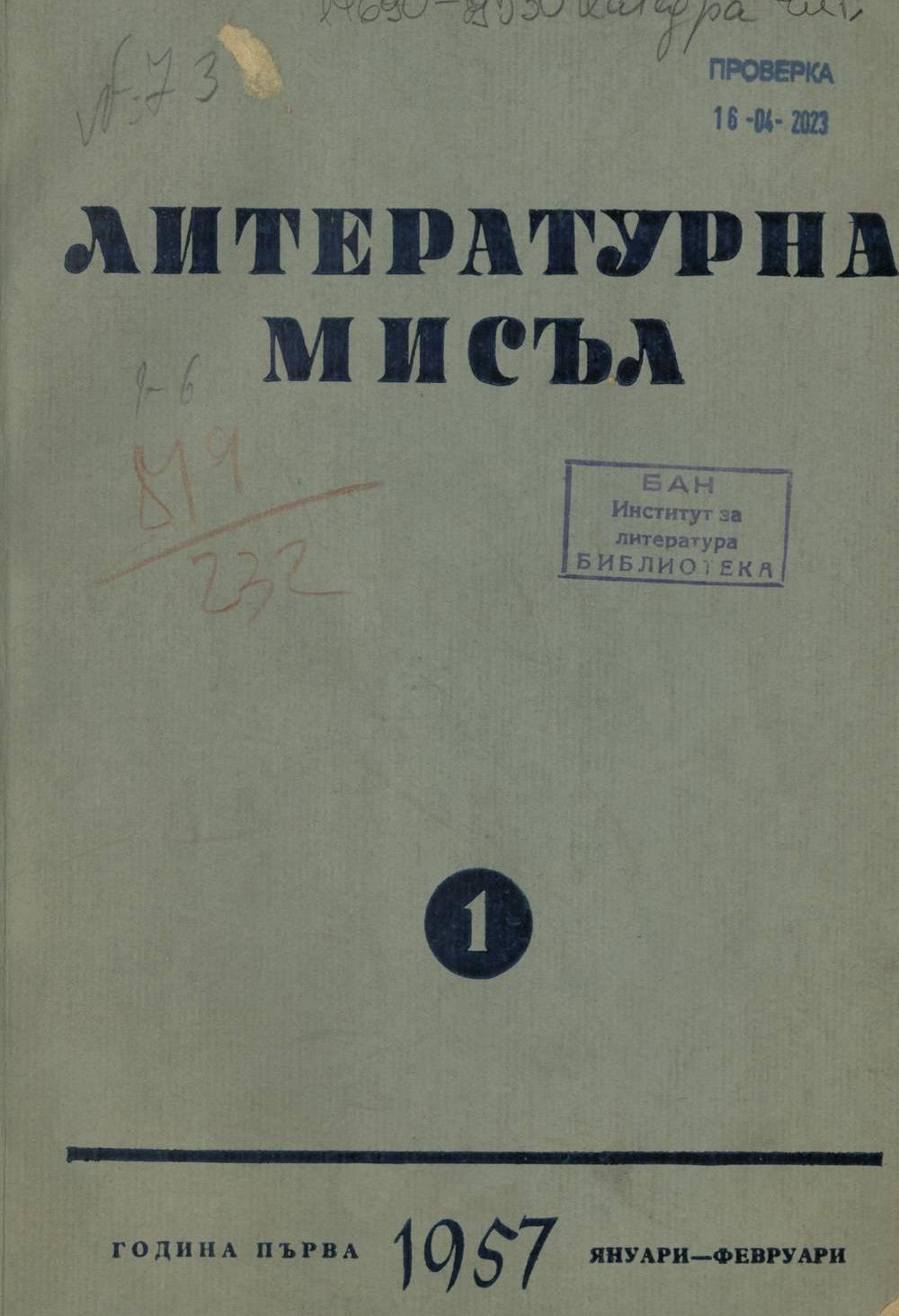
Literaturna misal Table of Contents 1957 issue 1
Free access
-
Summary/Abstract
SummaryTable of Contents 1957 issue 1Keywords: Съдържание
Literaturna misal * * * Introduction (On the occasion of the magazine)
Free access
-
Summary/Abstract
SummaryWhenever a new magazine was launched, there was always talk about the reasons why it was being published. And we are compelled to begin with such an explanation. And we do so with the deep conviction that Literary Thought, as a magazine devoted specifically to aesthetics, literary criticism, and literary history, is truly born out of necessity. A great creative revival is gradually taking place in our country. Issues that were neglected in the past but which needed to be brought to light are coming to the fore with increasing urgency. The magazine will discuss the fundamental questions of aesthetics. Its pages will clarify the laws of artistic creation, the place of the subject in art, and the qualities and characteristics of the "aesthetic." The magazine will pay particular attention to issues related to the psychology of the creative process. This important area remained outside the scope of our literary studies for almost the entire period after September 9. The blame for some incorrect assessments and unhealthy guidelines must also be sought in the waning interest in the problems of the psychology of creativity.
Todor Pavlov To the question of aesthetics as science
Free access
-
Summary/Abstract
SummaryEvery science is a science precisely because it studies, explains, and determines first and foremost what is common (a property, an essential relationship, a law) in the things and phenomena it studies. A science that is incapable of discovering and determining what is common in the object of its research is not and cannot be a science. This is, so to speak, an axiom confirmed by the entire development of all sciences without exception—philosophical and specific, natural and social, scientific-research and scientific-applied. Aesthetics as a science is no exception to this general rule. At the same time, everything that is general is general precisely because it is given in dialectical unity with the particular and the individual. The general, which does not constitute the deep and ever deeper essence of particular and individual things, but exists as pure, bare generality in and of itself and for itself, ceases in fact to have the character and significance of the general and becomes some kind of abstract, metaphysical and ultimately mystical idea, which in various idealistic theories acquires the meaning of a transcendental divine principle or some kind of transcendental value, etc. Something that is not common to at least two things (objects, phenomena) is not and cannot be common and therefore is not and cannot be any scientific concept, category, or law.Keywords: естетика, наука
Panteley Zarev Creative freedom or creative understanding of socialist realism
Free access
-
Summary/Abstract
SummaryThe freedom of the artist can be discussed in two aspects: socio-political and aesthetic. The artist is free in a socio-political sense when his work is not persecuted by the laws of society. This is the basic freedom that the great artists of the past lacked. "Genius," wrote Pencho Slaveykov, "always causes inconvenience. That is his feat." And indeed, it was a feat for the artist to preserve himself, to defend his independence against the attacks of society. Few have endured this struggle. Many artists have experienced the great sorrow of seeing harmful influences spread like poison in their souls, of seeing barely nascent ideas wither away. How much humiliation before the official authorities they have endured, how much cruel sorrow for the neglected pride of the creator. Today, we do not have the conditions that killed Geo Milev or, a little earlier, Yavorov. That is why I will not dwell on this side of the issue.Keywords: социалистическия реализъм, Творческа свобода, творческо разбиране
Stoyan Karolev Psychological Characteristics Questions
Free access
-
Summary/Abstract
SummaryThis concerns the psychological characteristics of characters in fiction. For a long time, these issues were neglected by both critics and artists. But recently there has been a revival, mainly in fiction. This came naturally, as a reaction against the simplistic understanding of socialist realism. In the recent past, we often repeated that in order to artistically recreate contemporary life, which is in constant motion and transformation, it is necessary for characters to be depicted in motion, in action, and not as Oblomov in bed. And this, generally speaking, is indeed the case. But we often forgot the old truth that art is the study of human nature, i.e., that it deals primarily with the human soul. And if the fiction writer fails to open up the souls of his characters to his readers, if he is content to describe their actions empirically, if he skims over the surface of the events in which they participate, he will deviate from his artistic goals and tasks and even risk falling outside the boundaries of art. There are many who have indeed found themselves there with some of their works. And after they got stuck, they began to remember the old truth.Keywords: въпроси, психологическата, характеристика
Pencho Danchev Notes on the playwrightry of Orlin Vassilev
Free access
-
Summary/Abstract
SummaryOrlin Vassilev began his literary career in 1926, immediately after the September Uprising and the bloody events of April 1925. These important events in our recent political history, as well as the post-revolutionary atmosphere in Bulgaria, left a deep mark on the work of this talented and socially conscious writer. On September 9, 1944, Orlin Vassilev was a widely popular, beloved, and sought-after author of novels, novellas, short stories, and a drama. Among his most significant works prior to September 9 are undoubtedly his novels The White Path and A Bandit's Mother Does Not Feed, the novella The Wild Forest, and a large number of short stories. A faithful disciple of our progressive realistic literature of the past and an ardent admirer of the great Russian classical literature, Orlin Vassilev created a number of works that earned him one of the top places in our contemporary fiction. Characteristic of the writer's creative method is his tendency toward broad philosophical generalization of artistically recreated events in life, as well as his active, restless intervention in the most difficult ideological and moral problems that excite a wide range of readers, which he raises and resolves in his works. Not only his works on contemporary themes, but also those that artistically recreate events from the distant past, such as the novel "Haidutin's Mother Does Not Feed," are also very relevant and sound contemporary in their subject matter.
Literaturna misal * * * Answers to J. Elsberg (Leningrad) and V. Gligoric (Belgrade)
Free access
-
Summary/Abstract
SummaryQuestion: How should we understand the concept of realism? Is it possible, and to what extent, to truthfully reflect reality in works of art belonging to other art movements? Answer: By realism, I understand the creative method and movement that formed under certain historical conditions and changed significantly during different historical periods. It seems to me, as well as to a number of scholars, that realism in Western Europe first emerged during the Renaissance, finding its most powerful expression in the works of Shakespeare. One of the fundamental distinguishing features of realism lies in its unique approach to the creation of a typical character. By freeing itself from mythological ideas about human personality and will, realism came to depict character in its deepest individualization, in its self-development. Whereas in previous eras, literature, in creating characters, proceeded from previously "given" aesthetic norms that determined for themselves the ideal, the sublime, or the ugly.Keywords: Отговори, Я. Елсберг, Ленинград, В. Глигорич, Белград
Ganka Naydenova-Stoilova In the creative laboratory of writer Dimitar Talev
Free access
-
Summary/Abstract
SummaryThe self-observations of creative individuals provide the most valuable data through which we can gain insight into an insufficiently studied field and place research on the creative process on a sound scientific footing. Books such as Goethe's Conversations with Eckermann, Fr. Hebbel's Diaries, or Stanislavski's My Life in Art are a rich source both for researchers of the personal work of these artists and for scholars who want to establish the general patterns in the creative process. After all, such personal confessions by significant artists are always solid and powerful nourishment for any young talent.Keywords: лаборатория, Димитър Талев, писател
Lyudmil Stoyanov Questions Answered by Soviet Literator D. F. Markov
Free access
-
Summary/Abstract
SummaryWhat poems did I write before becoming fascinated with symbolism? What was my youthful poetry like? Like every beginning poet (1903–1904), I had not one but several notebooks filled with poems. These were poems in the spirit of folk heroism, written under the influence of Botev, Vazov, and P. R. Slaveykov. I was able to restore a small part of them in the 1954 collection Poems. In 1905, I moved from Plovdiv to Sofia with the intention of studying and supporting myself with my own work. I stayed with a classmate I knew, who later took these poems with him, and for a long time I saw some of them printed in provincial newspapers under his name. In 1905, I was greatly impressed by Pushkin's poem "Vechny Oleg" in Pencho Slaveykov's translation. Pushkin and Lermontov became my favorite poets. Their poetry was of such high quality that it could not be imitated. I began to translate it, clumsily at first. In 1907, I read my translation of Lermontov's "The Demon" to a student audience. The impression was encouraging. I usually translated Pushkin and Lermontov under difficult circumstances (in prison, at the front, in hospital, in exile), with a feeling of love and gratitude for their genius. This raises the question: why did I not remain faithful to my love for the poetry of Pushkin and Lermontov? How can my enthusiasm for symbolism, shared by other Bulgarian poets of that period (1905-1915), be explained?Keywords: Д. Ф. Марков, Отговори, въпроси
Ganka Naydenova-Stoilova Unknown letters of Yavorov to Dr. K. Krastev
Free access
-
Summary/Abstract
SummaryThis series of letters by Yavorov touches upon a particularly significant moment in his creative career. The year he spent in Pomorie was a time of continuous creative growth. It was then that some of the poet's most significant works were written and conceived, such as "Kaliopa," "Armenians," "By the Hearth," "Hailstorm," and others. Yavorov's Anchialos notebooks record new poems almost every day, with ever new poetic ideas, evidence of an extraordinary creative fervor. The first issue of the magazine Misul ot novi vek (Thought from the New Century) begins with "Kaliopa." Dr. Krastov and P. P. Slaveykov already show a personal interest in the new brilliant talent and, with particular generosity, give him his deserved place in their magazine. They corresponded with the unknown telegraph operator and arranged for him to move to Sofia. This generous recognition undoubtedly contributed to the blossoming of the young poet's creative powers. This generous recognition undoubtedly contributed to the blossoming of the young poet's creative powers. According to his own words, half of the red collection "Poems" was written during that year, 1900. At the end of the same year, I published the collection. Even before its appearance, within a few months, I became the most popular poet in Bulgaria." (Dr. M. Arnaudov, "Towards the Psychography of P. K. Yavorov," Sofia 1916, p. 25).Keywords: Яворов, д-р К. Кръстев, Неизвестни писма
Gocho Gochev Victory of Realism
Free access
-
Summary/Abstract
SummaryLast December, our country celebrated the centenary of its national theater. In the capital, this remarkable anniversary could have been marked more solemnly, with the most prominent representatives of our contemporary theater appearing on stage in roles dear to all of us. So many foreigners, prominent theater figures from their countries, had come! The high praise they gave to this remarkable century deserved a slightly different anniversary celebration. In the anniversary production of "Ivanko," with the exception of P. Gerganova, our greatest artists were not used. And the celebration calls for such a selection... Perhaps the current concerns of everyday theater life, when everyone is more preoccupied with themselves, inadvertently underestimated the celebration... But sometimes disappointment accompanies even our brightest days.Keywords: Победа, реализма
Lyudmil Stoyanov A marked humanist of our time. For the 50-year literary, scientific and social political activity of academician Todor Pavlov
Free access
-
Summary/Abstract
SummaryWhen we met with Todor Pavlov in his office in the first days after September 9, 1944, among the many conversations I said: "How wonderful it is when justice prevails. ... Indeed, justice was triumphant in those days: the partisan detachments came down from the mountains after a long and hard struggle, adorned with pine branches, ivy, and geraniums, the prison doors were opening to release the fighters for social justice, the victorious Soviet army was marching westward and sweeping away the remnants of the brown plague... It was also just that he, Todor Pavlov, on behalf of the party, was at the helm of the state. He raised his hand with his characteristic gesture and said in a tone that brooked no objection: "Justice - that is our goal."Keywords: хуманист, политическа дейност, Тодор Павлов, обществено-политическа
Atanas Natev A prominent literary theorist. For the 100th anniversary of the birth of G. V. Plehanov
Free access
-
Summary/Abstract
SummaryEvery anniversary marked on the calendar implies some new expression of respect for the work that has left its mark on human history. But while this is sometimes due to the simple similarity between dates, the centenary of G. V. Plekhanov's birth has a different, very different meaning. Widely celebrated by the Soviet and progressive world community, this anniversary fully confirmed the recent desire to boldly master and more fairly reevaluate Plekhanov's philosophical and aesthetic legacy.Keywords: теоретик, литература, Г. В. Плеханов, рождение
Georgi Dimov An Important Step to Know and Study Our Literary Heritage
Free access
-
Summary/Abstract
SummaryThe increased interest in our cultural heritage requires us to approach it critically, with love and understanding, with scientific awareness and civic responsibility. From a serious publication, our contemporary reader must learn when and under what specific historical conditions the work was written, what the writer's subjective creative motives were, and how to understand certain ideological and aesthetic peculiarities. The need for a critical apparatus is particularly important in the case of works whose authors have followed a complex and contradictory ideological and creative path. The comprehensive critical edition of Ivan Vazov's works is a serious attempt to present the work of the great Bulgarian classic in a form that meets the requirements of people with different interests and is at the level of the current development of our literary and archaeographic science.Keywords: опознаване, изучаване, литературно, наследство
Ivanka Boyadzhieva A Play of Love and Honor
Free access
-
Summary/Abstract
SummaryIn his very first play, Kamen Zidarov demonstrated the distinctive features of his dramatic talent—vivid characters that convey the atmosphere of the time, exciting conflicts, and national color. But in Tsarska Milost, the fast-paced dramatic line is broken by a certain slowness and narrative style, by a certain disruption of the dramatic unity. What distinguishes the play "For the Honor of the Uniform" from "Royal Mercy" is the more clearly expressed conflict, the constantly intensifying dramatic tension, and at the same time the greater compositional coherence. The entire structure of "For the Honor of the Uniform" is more perfect, which shows that Kamen Zidarov's dramaturgical mastery has strengthened. At the center of the play, the playwright has placed a deep psychological conflict. Using the tools of drama and powerful dramatic situations, Zidarov has attempted to unfold the complex emotional drama of K. Zidarov, For the Honor of the Uniform, a drama published in the magazine Theater, vol. 6/1956. A man in whom the forces of love struggle with the forces of duty and honor. A great achievement for the author is the fact that he brings to the forefront in the play the psychological contradictions, the personal drama of the man. The clash between love and duty, the conflict between the dream of personal happiness and social obligations, is an old theme in drama. Kamen Zidarov has resolved this eternal problem in a new, original way, in a communist way.Keywords: Пиеса, любов, чест
Krastyo Goranov Interesting work on aesthetics
Free access
-
Summary/Abstract
SummaryWe have before us a truly interesting, passionately and vividly written book. The author boldly raises some fundamental questions of aesthetic science that have often been sidestepped in recent times. The central problem that has completely absorbed Burov's attention is the relationship between "the subject and content of art." Everything else is subordinate to this problem. What is said about the function of art is an illustration of the main thesis about the peculiar subject and content of art. In the first chapter, Burov criticizes the widespread view that the subject of art is the whole world and that its specificity arises not from the subject, but from the form of reproduction of life (the figurative form). Of course, the reflection of life in the "form of life itself," in a living, concrete, individual image, is a very important feature of art. But imagery is also inherent in science, photography, and the practical activities of people. After offering an interesting and accurate critique of Kant and Schiller on the one hand, and of some Soviet theorists on the other, Burov comes to the following conclusion: Imagery is not an essential specific feature of art. It explains nothing and must itself be explained. The whole point is in the specific subject matter of art, which gives rise to the specific figurative form. What is this subject matter? All true artKeywords: Интересен, труд, естетика